Putting the “Natural” in Natural Law

– by Carlton Patrick

When Clarence Thomas was nominated to serve on the United States Supreme Court, it was Joe Biden, then a Senator from Delaware, who chaired the Senate Judiciary Committee and oversaw the confirmation process. During the hearing, Biden questioned Thomas at length on his views on natural law, saying that while the discussion might “confound the people…whether someone applies natural law is of phenomenal significance, and there is not a single legal scholar you can question who would not tell you that is not true.”

To understand why Senator Biden was so invested in this line of questioning, it is helpful to consider the category of legal disputes that the philosopher Ronald Dworkin calls hard cases. These are instances where a judge must decide a novel controversy that isn’t determined by an existing statute or case law and so the judge must therefore make new law herself. There are countless variations of what principle the judge could use to decide the case. She could decide the case in a way that produces the most equitable or egalitarian result. She could make law that would maximize economic efficiency. Or she could make law that would emphasize conflict reduction, or safety maximization, for example.

But adherents to the natural law philosophy—a list that not only includes Justice Thomas, but also Aristotle, St. Thomas Aquinas, Hugo Grotius, and John Locke—posit that a true, objective set of moral principles exists out in the universe and that laws are only valid to the extent that they conform to this set of principles. Thus, in the face of a hard case, the judge cannot choose among orthogonal principles, and instead must make the positive (or man-made) law accord with the objective natural law that wafts through the ether. Otherwise, the law is simply not valid.

Where do we look to determine these objective principles of natural law? For a long time the dominant theory was that these principles emanate from God(s). Modern defenders of the natural law approach point to a variety sources including Gods, the universe, moral truths, and other metaphysical sources. Regardless of the source, though, most natural law proponents agree that there are certain universal values that are revealed to us through instinct and intuition, and that, as the legal philosopher Jonthan Crowe phrases it “we are characteristically disposed to pursue…and regard them as normatively worthwhile.” Justice Thomas phrases it this way: “the thesis of natural law is that human nature provides the key to how men ought to live their lives.”

What I argue in my article Evolution is the Source, and the Undoing, of Natural Law, is that there is danger in this sort of thinking. Rather than automatically deferring to our gut intuitions, we should investigate where they come from, and use that as the jumping off point for policy discussions about how to make law.

The natural law philosophy derives much of its momentum from the fact that our moral intuitions seem immutable. They are often widely shared, instinctual, robust to temporal and cultural differences. They emerge early in childhood, and are impervious to counter-argument. And it is true that legal codes from vastly different cultures and from different millennia have common features, lending credence to  Cicero’s assertion that the law is “not one thing at Rome, and another thing at Athens” but is instead “universal…unchanging and everlasting.”

But these phenomena can be explained without resorting to superstition. Thirty years of empirically validated evolutionary studies have provided us with a scientific framework for explaining that the reason we share so many moral intuitions, that they show up early in development, and that take on a deontological force is that they are part of our species-wide psychological architecture. They helped to navigate the conflicts inherent in the highly social world of our ancestors where censuring certain actions while praising others would have had significant social consequences. For example, our moral conscience—the intuition that personally taking an action would be the “right” or “wrong” thing to do—helps us accrue praise and reputational clout while avoiding condemnation and punishment. Likewise, our intuitions of justice facilitate the proactive condemnation (and reactive punishment) of certain behaviors by marking those behaviors as ‘wrong’ and attaching an intuitive degree of severity to their wrongness.

Cast in this light, the rubber-stamping of intuition into law urged by the natural law philosophy begins to take on a different view, and many will immediately recognize this as a version of the naturalistic fallacy. By automatically incorporating our moral intuitions into law, we are saying that simply because something evolved, it is per se good, and per se worth institutionalizing. But these intuitions—like all of our intuitions—exist not because they were passed down from a divine arbiter of truth, but instead because they likely granted some fitness advantage to their holder. And, as a result, these intuitions—like all of our intuitions—have the potential to lead us in a wayward direction.

Just as our folk intuitions of physics, economics, or probability can lead us to irrational, inaccurate, or counter-productive conclusions, our moral intuitions can be similarly flawed. They can be selfish, nepotistic, myopic, and capricious. We think the same action is more wrong when it’s done by someone outside of our political group, and less wrong when it’s one of our comrades. We are mortified at the thought of our neighbor’s child dying of hunger but are unmoved when it routinely happens to children living in a Cambodian slum. We flip-flop our moral positions when there is money or reputational benefit associated with doing so. In other words, when consistency in moral judgments runs up against the self-interest of the person making the moral judgment, it is self-interest that often prevails.

In evolutionary terms, these quirks of our moral intuitions are features, not bugs. They would have likely been quite advantageous in terms of navigating the types of recurrent conflicts of interests our ancestors faced. There are no doubt evolutionary advantages to favoring our political allies and our neighbors, or to endorsing different moral positions when doing so would result in a greater economic or coalitional position for us. But, I argue, the fact that our moral intuitions are skewed in these directions is reason enough to give us pause, and to require an argument why (as opposed to a presumption that) they should be used in lawmaking.

Read the original article: Patrick, C. (2023). Evolution is the source, and the undoing, of natural law. Evolution & Human Behavior, 44(3), 175-183.

This article is part of a special issue of Evolution & Human Behavior on Evolution, Justice and Law, edited by Debra Lieberman & Keelah Williams.

Stereotypes of criminality in the U.S. track ecology, not race – part of EHB Special Issue on evolution, justice and the law

– by Keelah Williams

In the United States, Americans stereotype Black individuals as being more likely to commit certain types of crime than White individuals. But is this really about race alone? Or might people sometimes use race to infer the kinds of environments others might inhabit and the behavioral predispositions those environments might incentivize?

In a paper recently published in Evolution and Human Behavior, I argue that beliefs about who is (or is not) likely to commit particular crimes are actually driven by inferences about the kinds of environments (“ecologies”) people come from. People from resource-poor and unpredictable ecologies are stereotyped as engaging in more criminal behavior than people from resource-rich and predictable ecologies. And because the legacy of racism means that race and ecology are intertwined in the U.S., American perceivers use race as a proxy for ecology: They tend to infer that Black people are more likely to dwell in “desperate” ecologies, and White people are more likely to dwell in “hopeful” ecologies.

In a series of three studies, I show that—in the absence of information about the ecology of the target individual—American perceivers stereotype Black targets as more likely to commit crimes such as drug possession, resisting arrest, and vehicle theft than are White targets. But when perceivers are provided with both race and ecology information about the targets, perceivers’ stereotypes track ecology but not race: White and Black targets from resource-poor and unpredictable environments are stereotyped as equally likely to commit those crimes. And, White and Black targets from resource-rich and predictable environments are stereotyped as equally unlikely to commit those crimes. These findings suggest that beliefs about others’ criminal propensities may not be driven solely by race per se but may instead reflect inferences about the behavioral disposition of people who come from hopeful or desperate ecologies.

These findings have practical implications for reducing racial bias in the criminal justice system. Previous work suggests that Black criminal offenders receive harsher punishments for the same crimes because they are seen as more dangerous and likely to reoffend than White criminal offenders. But if people’s beliefs about whether someone is predisposed to commit different crimes are driven by ecology rather than race, this suggests that race differences in legal outcomes could be reduced to the extent that targets are described as hailing from similar ecologies. (The appropriateness of using ecology information when making legal decisions is a separate question, however—especially because many cues to ecology may be outside of the person’s control.)

This paper was published as part of a Special Issue on Evolution, Justice, and the Law that I edited with Debra Lieberman. Evolutionary social science and the law are natural complements: The former seeks to understand behavior while the latter seeks to regulate behavior. As the articles in the Special Issue demonstrate, an evolutionary approach has immense value in the legal sphere because it has explanatory power, generates novel predictions for legally relevant behavior, and provides insights that inform normative debates in the law.

The articles in the Special Issue are grouped into five broad themes. The first theme—including papers by Carlton Patrick, Daniel Sznycer, Peter DeScioli, and Aaron Sell—considers the origins of moral judgments. Is there an objective set of moral principles independent of law? How do intuitions about justice arise? And should such universal intuitions guide lawmaking?

The second theme—including papers by Sarah Brosnan, Owen Jones, and Jeffrey Stake—addresses the topics of ownership and fairness. How do adaptations generate decisions to retain or relinquish material goods? What can the non-human primate literature tell us about the modern human sense of fairness and justice?

The third theme—including papers by Cass Sunstein and Keelah Williams—explores contextual factors that influence legal judgments. How does the prevalence of societal problems affect our categorization of what is problematic in the first place? And, as the beginning of this blog addresses, what best explains people’s propensity to infer criminality—ecology or race?

The fourth theme—including papers by Michael Guttentag and Douglas Yarn—examines the extent to which law influences cooperative behavior. How are laws regarding resource distribution influenced by our evolved dispositions? When might extralegal channels of dispute resolution (e.g., dueling) promote cooperative relationships more than adjudication?

Finally, the fifth theme—including papers by David Buss, Kingsley Browne, and Martin Daly—touches on matters of sex and death. How do evolved sex differences affect perceptions of what is legally objectionable and the existence of disparities in the workplace? What role does inequality play in homicide rates? How can an evolutionary perspective help solve societal problems on a macro scale?

Altogether, the Special Issue offers a variety of papers that explore how our evolved psychology generates intuitions, preferences, and behaviors in the legal sphere. Debra and I hope you enjoy this Special Issue representing a burgeoning research program at the intersection of evolutionary science and law.

Read the original article here: Williams, K. (2023). Stereotypes of criminality in the U.S. track ecology, not race. Evolution & Human Behavior, 44(3), 255-263.

This is part of a special issue of Evolution & Human Behavior on Evolution, Justice & Law, edited by Keelah Williams & Debra Lieberman

On the origin of laws by natural selection

– by Peter DeScioli

Why do humans make so many laws? In a new article, I argue that the human ability to make laws evolved by natural selection. I hope to entice you with a few snapshots.

Laws may seem unlikely to come from evolution. There are so many laws, and they differ so much across societies. This variation shows that natural selection did not install a single code of laws in the human mind. We do not have ten commandments, or five or twenty, etched into our minds, or else we would see the same code of laws repeated in society after society.”

But does this mean that human evolution has little to tell us about the origin of laws? Not at all. To see why, just compare laws to tools. Humans make countless tools, and tools vary tremendously across societies. Yet, it is well-understood that humans evolved adaptations to make and use tools. The human mind does not have a fixed set of blueprints for ten or twenty tools. Rather, natural selection installed in the mind principles of physics and engineering that humans use to make new tools for new purposes. The same is true of laws: Humans evolved a creative power to make limitless laws by applying a stock of core principles. Humans are lawmakers like we are toolmakers.

With this in mind, we can dissect a sample of laws to find the common parts that humans use to make them. The parts of laws are ideas that we compose into messages, such as Thou shalt not kill, and Whosoever lieth with a beast shall surely be put to death (Exodus, 22:19). Some of the ideas that come up repeatedly include indefinite people such as thou and whosoever, actions such as kill, steal, and lie with, intentions such as wanting and planning, as well as truth, impartiality, possibility, necessity, punishment, and proportion.

Having laid out the parts of laws, we can then inspect them for clues about their evolutionary purpose. What is all this lawmaking for? How do humans use laws in evolutionary competition?

We first consider an apparent likeness between laws and threats. Threats are well-understood signals in games of conflict, and like laws, threats warn of punishment that is conditional on some event, such as If you come any closer, then I will punch you. However, on close inspection, we find that threats and laws differ in each of their parts. For instance, threats address a definite person while laws address an indefinite person, and threats are enforced by the threatener while laws are enforced by the whole community. Given these and other differences, we conclude that laws are not the same as threats, and thus cannot be explained by theories of threats.

Next, we compare laws to moral rules and find a close match:

Like laws, moral rules apply to everyone, they set a condition that is a specific action and requires evidence, they concern an infinite variety of actions, they are enforced by everyone with blame and punishment, and the punishment is proportionate. Moral rules match laws part for part. (DeScioli, 2023, p. 199)

Given this correspondence, we conclude that laws are produced by moral judgment. Moreover, I have previously argued that moral judgment evolved as a strategy for choosing sides in conflicts. Humans use the moral strategy to avoid some of the dangers of choosing sides by alliances and hierarchies. In the moral strategy, people choose sides by rules of action, like opposing a thief according to the rule, Thou shalt not steal, rather than choosing sides by alliances or hierarchy, such as supporting an ally or superior who stole someone’s goods. And since moral judgment is the source of laws, the parts of laws are also patterned by the same function: choosing sides in conflicts while avoiding the dangers of alliances and hierarchy.

Hence, we have found the origin of laws in our strategies for choosing sides. But we are not finished. The ability to make laws creates new games and spurs a multitude of strategies and counterstrategies:

The evolution of laws is not the end of the game but only the beginning. Once humans can compose laws to settle conflicts, the next problem is that they can make too many…. As prolific lawmakers, humans can easily produce a multiplicity of laws too numerous to remember and too discordant to apply. (p. 202)

To prevent a chaotic proliferation of laws, humans evolved the ability to debate which laws to accept into the community’s code and which to reject. Moreover, each person judges potential laws according to their own interests, so people inevitably disagree on many laws, giving rise to a battle to control the laws.

When many people disagree on a law, it is unstable and varies over time and across societies.… Locked in disagreement, the opponents struggle in a tug of war to control the law. (p. 202)

Last, I illustrate the competition to control the laws by examining common skirmishes over laws of violence, property, sex, factions, and power. In each case, we see how opponents struggle to enact opposite laws, meaning laws that would punish opposite sides in a conflict. We also encounter what I call paradoxical laws, such as Thou shalt not betray our faction. Paradoxical laws mimic the characteristic form of laws despite the fact that they undermine the rule of law in general, replacing it with the rule of faction or hierarchy.

The struggle to control the laws also damages science, because committed partisans condemn facts and ideas that could weaken the case for the laws they favor. Indeed, this may be why “the science of human evolution itself has long been accused of subverting the foundations of morality and society” (p. 207). In closing, I offer a defense against this charge:

In defense, it may help to point out that human evolution does not affirm a single code of laws but rather explains why humans make a great variety of laws and then fight to control them. (p. 207)

Read the original article here: DeScioli, P. (2023). On the origins of laws by natural selection. Evolution and Human Behavior, 44(3), 195-209.

This article is part of a special issue of Evolution & Human Behavior on Evolution, Justice and Law, edited by Debra Lieberman & Keelah Williams

What’s law got to do with it?

– by Michael Guttentag

Law has played a pivotal role in the emergence of human sociality. If this conjecture is correct many questions naturally follow. When and why did the turn to law emerge? How could law have played a role in the distant past if powerful sovereigns are a comparatively recent development? What distinctive contributions does the legal system make to the maintenance of social order?

In Evolutionary psychology and resource-sharing laws I explore these and other questions by considering laws that serve a particular purpose – sharing resources. Resource-sharing laws are laws that encourage cooperation and discourage competition.  One simple example of a resource-sharing law is a law that limits private property rights, because such a law will reduce the incentive to compete rather than cooperate for scarce resources.

Concepts of law

A first step in addressing questions about law and the emergence of human sociality is to note that there are a multitude of ideas about what law is. One concept of law views the law as the commands issued by a sovereign and backed by a credible threat of punishment. This concept of law was popularized by John Austin in the Nineteenth Century, and suggests that law is a relatively modern affair, contingent on the existence of a sovereign powerful enough to command obedience (Austin, 1863, The province of jurisprudence and uses of the study of jurisprudence).

An alternative conceptualization of what law is comes from H. L. A. Hart and his 1960 masterwork “The Concept of Law” (Hart, 1960, The concept of law). In Hart’s account law’s uniqueness comes from the combination of two distinctive features: normativity and a two-tiered rule structure. According to Hart, unlike commands obeyed under threat of force, laws are obeyed because people to at least some degree accept the law as describing how people ought to behave. This is the normative aspect of law.

The second defining feature of law according to Hart is the way legal systems are constructed. Unlike other normative systems, the law contains both rules and rules about rules, or, in Hart’s terminology, both primary rules and secondary rules. Primary rules delineate when people “are required to do or abstain from certain actions, whether they wish to or not,” and include “restrictions on the free use of violence, theft, and deception,” and “various positive duties to perform services or make contributions to the common life.” Secondary rules describe how to “introduce new rules of the primary type, extinguish or modify old ones, or in various ways determine their incidence or control their operations.”

The combination of primary and secondary rules, law’s two-tiered structure, creates a generative system for establishing normative obligations much as language provides a nuanced, flexible, and generative way for humans to communicate. The possibility that law has played a pivotal role in the emergence of human sociality makes sense if one begins from Hart’s view as to what makes law a distinctive normative system.

Outlawing polygyny

One historically important resource-sharing law is the polygyny prohibition. Studying this prohibition highlights several ways laws contribute to the maintenance of a cooperative society. The polygyny prohibition is typical of a resource-sharing law in that it works by reducing the gains that can be realized by engaging in competitive behavior, in this case reducing the benefits granted to those who secure additional mating partners. Laws prohibiting polygyny are among the first recorded laws, dating back to ancient Athens, and illustrate several of the benefits of using a legal system to share resources. First, the public process of defining that a rule is a law makes reversing course more difficult. In this way the law can make commitments to arrangements that discourage competition such as the polygyny prohibition more credible. Second, the presence of a law in the historical record provides a meme that is easy to replicate. The family law provisions adopted by Solon around 600 B.C.E. have provided a template for millennia of one way a society can modify marital practices to reduce competition for mates.

Origins of a law instinct or norm psychology

The use of legal rules to facilitate resource sharing can also provide insight into how an ability to use this kind of generative normative system (a law instinct or norm psychology) may have emerged. Big game hunting, a formative practice in shaping human behavior, presents the kinds of resource-sharing opportunities and challenges that laws designed to share resources are particularly well-attuned to address. Successful big game hunting requires balancing individual and cooperative interests. A legal regime limiting the private property claims of individual hunters could encourage cooperation and might be quite helpful in this context. Moreover, our ancestors’ ability to “solve” the meat-sharing problem by defining what constitutes communal property and what constitutes private property might have provided a pathway to develop a broader tendency to use a generative normative system to “solve” resource-sharing problems.

Divvying up transaction surplus

Another insight from exploring resource-sharing laws as a window into law’s roles in the maintenance of a cooperative society is that this line of inquiry helps to explain aspects of the nuanced relationship between prosociality and transactions with strangers in market transactions. There are well-established competing hypotheses about the link between participation in market transactions and prosociality. As Albert Hirschman observed, on the one hand, there is the “doux commerce” thesis that commerce is “a civilizing agent of considerable power and range.” On the other hand, there are concerns that “capitalist society … exhibits a pronounced proclivity toward undermining the moral foundations of any society” (Hirschman, 1982, Rival interpretations of market society: Civilizing, destructive, or feeble?)

Largely absent from this debate is the question of how parties to market transactions divvy up any gains from trade. Gains from trade present the kinds of resource-sharing challenges that resource-sharing laws are designed to address. This insight generates testable hypotheses. The ability to successfully divvy up transaction surplus might moderate the relationship between participating in market transactions and prosociality. If this is correct, then the relationship between prosocial attitudes and participation in market transactions should vary depending on market structure. Where there is one price at which all transactions take place, there is less of a need for cooperation because the market price provides a ready-made mechanism with which to allocate transaction surplus. In contrast, in a market characterized by a series of independent bilateral negotiations the challenge of sharing transaction surplus in a fair and efficient manner needs to be addressed each time a transaction is consummated. As a result, at least some amount of prosociality may be helpful or even generated when participating in a bilateral negotiation.

Work by Armin Falk and Nora Szech shows how an experiment could shed light on this hypothesis by exploring whether market structure moderates the relationship between prosociality and participation in market transactions. Falk and Szech did not find a statistically significant difference on their measure of moral values between treatments in which transactions were executed by bilateral trade and in which transactions took place at a pre-set price. Their work does, however, suggest ways to further explore the hypothesis that divvying up transaction surplus explains at least some part of the nuanced relationship between prosociality and participating in market transactions.

These ideas and others in the article Evolutionary psychology and resource-sharing laws show how considering resource-sharing laws in the context of evolutionary psychology generates a variety of insights as to how and why law may have played a pivotal role in the emergence of human sociality.

Read the article: Guttentag, M. (2023). Evolutionary psychology and resource-sharing laws. Evolution and Human Behavior, 44(3), 264-271.

This article is part of a special issue of Evolution & Human Behavior on Evolution, Justice, and the Law, edited by Debra Lieberman & Keelah Williams.

To Duel or Not to Duel?

– by Douglas Hurt Yarn

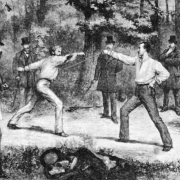
As social group members, you and I might come into conflict over resources if the physical or social environment creates scarcity. If we chose to compete over our conflicting claims, we are disputing. We could fight over it, but the legal institutions of functional modern states discourage physical aggression and offer adjudication as an alternative way to compete. In lieu of violence, we can just sue one another. But what if you had the choice to challenge me to a duel? After reading my essay, Evolution and Dueling Dispute Processing, you might prefer dueling.

The last documented formal duel in the U.S. started with a lawsuit. After a hearing before the court, the two lawyers in the case had a heated exchange. A challenge was issued, and Rodolph Rufus Richards and Samuel Barnard Adams prepared to face each other with pistols a few days later. By 1877, dueling had long been illegal in Georgia and carried severe penalties, but the process provided a remedy and outcome that the law could not. Contrary to the popular conception of dueling, they rarely resulted in injury or even a pull on the trigger. The formal duel was a mode of dispute processing conducted under strict rules that emphasized conciliation. As in most cases, Richards and Adams reached a compromise through the mediation of their “seconds.” Their honor was preserved (a precious economic resource), and their relationship reconciled. They shared a carriage back to Savannah, became lifelong friends, and prospered in their subsequent legal careers. In contrast, their clients continued to fight it out in the courts, and the acrimony from that adversarial process forever ended that relationship. In short, adjudication ended their clients’ relationship while dueling allowed Richard and Adams to adapt their relationship to a new stable cooperative equilibrium.

The Richards-Adams duel is a story about how adjudication and conciliation play different roles in managing conflict in human societies. At the most basic level, the fitness of any collective requires a cooperative equilibrium—stable, ongoing cooperative (or mutually exploitive) relationships among its members. Cooperative equilibria are difficult to achieve, because individual cooperators must sacrifice some of their potential fitness for the benefit of the collective. Moreover, because of their proximity and interdependence, cooperating individuals are more likely to come into conflict with each other, especially as environmental changes undermine the existing cooperative equilibrium. The situation is ripe for defection, in game theoretic terms, and potential calamity. As Darwin noted, when the bees stop cooperating, the hive collapses. Some form of conflict management system is essential to maintain cooperation among group members in the face of pressures to defect. That system needs both conformity and reconciliation. Behaviorally, this translates to reciprocity and forgiveness. The cultural extensions of these phenotypes include law and conciliation.

Law operates both before conflicts and after disputes, primarily to enforce conformity to cooperative norms through the threat of punishment. Conciliation operates after disputes to promote reconciliation and new stable cooperative equilibria. But these functions can be in conflict. As influential legal philosopher Lon Fuller persuasively argued in a series of articles 50 years ago, the dispute processing mechanism provided by law – adversarial adjudication – is both an impediment to conciliation and an inefficient way to solve polycentric and non-zero-sum problems because it inhibits creative and flexible relations. By actively discouraging expressions of forgiveness and contrition, adjudication is more likely to destroy any potential of an ongoing cooperative relationship and a new more adaptive equilibrium. Admittedly, it’s sometimes healthier to end a particular relationship, but this may fail to address the underlying problem or conflict, from which future disputes may arise. Furthermore, there can be a conflict between legal norms created through adjudication and the more efficient social norms adopted or created in conciliatory processes. Conversely, conciliation can impede the adaptive and conformity functions of law in a large complex society, because it slows the creation of more efficient legal norms that promote cooperation at scales beyond the disputants. Moreover, serial defectors can use conciliatory processes to avoid the potentially harsher outcomes of adjudication.

When conformance and reconciliation are in conflict when managing social conflict, the law exerts a powerful role over any compromise. Anglo-American legal institutions have struggled for centuries to find the right balance between these two modes of dispute processing. As the state grows stronger, its legal institutions tend to favor adjudication, leading to the classic “if you only have a hammer, every problem is a nail.” Currently in the U.S. and many other Western societies, legal institutions have developed their own systems to offer forms of conciliation, raising concerns about the effect on the very ethos of such processes.

So, should you sue or duel? Your individual choice and the institutional incentives that shape it may have far reaching effects on social evolution and the fitness of the social group.

Read the full article: Yarn, D.H. (2023). Evolution and dueling dispute processing. Evolution & Human Behavior, 44(3), 272-277.

How the mind decides to help and harm: Welfare tradeoffs among US and Argentine students and members of the Shuar and Tsimane of the Amazon

– by Andrew Delton

“It is interesting to contemplate an entangled bank, clothed with many plants of many kinds, with birds singing on the bushes, with various insects flitting about, and with worms crawling through the damp earth” (Darwin, 1859, Origin of Species). As we stand beside a river and gaze at such a bank, images enter our minds unbidden. We need not cogitate to see the warblers and the dragonflies, the churn of the water, or the moss-covered rocks. Our perception of the scene feels unmediated.

This, we know, is an illusion. Vision arises from a fiendishly complicated set of adaptations, including eyes for capturing photons bouncing off nearby objects and computations performed by the nervous system for turning this raw sensory data into a useful picture of the world.

Feelings, too, enter our minds unbidden. When our child comes crying to us with a scraped knee, warmth rises in our breast and we want to console her. When a friend needs us to cover the check, we are only too happy to do so. When an enemy commits a faux pas, a bolt of cold glee takes hold—this accidental gift will help us burnish our reputation at his expense.

Desires to help or harm also feel unmediated. But, as with vision, are these desires also created by complex and largely unconscious computations? Our team, including Daniel Sznycer, Adrian Jaeggi, Julian Lim, and other collaborators, designed a series of studies to find out.

We studied how people decide to help or harm, specifically whether they do so with precision. We suspected that the felt simplicity of these desires is actually created by computations involving precise variables. These variables encode how much a person is willing to trade off their own welfare to help or hurt another person. Given their function, we call them welfare tradeoff ratios.

In our studies your task was to decide whether to give one sum of money to a specific other person (perhaps your best friend or an acquaintance) or to keep a different sum of money for yourself. For instance, would you take $54 for yourself or give your friend $37? Probably you’d take the $54. But what if you would get only $46? Or $39? Or $31? Now you might switch to giving the $37 to your friend.

We had participants make many decisions (in some cases up to 60). Across decisions, we varied exactly how much money was at stake for both people. In most, you decided whether to pass up money for yourself to give to the other person—helping. More rarely you decided whether to pay to prevent the other person from getting money—harming.

To measure precision, we examined how consistently participants chose who got what. For instance, if you would forgo $46 to give your friend $37, it would be inconsistent to later keep $31 for yourself rather than give your friend $37. Why pass up a large amount only to keep a smaller sum? If precise variables for welfare tradeoffs create desires to help or harm, we predicted that people would make few inconsistent decisions. Were we correct?

First, we studied university students in the United States and Argentina. As suspected, they were very consistent when deciding to help or harm. We measured consistency in two ways. One way was strict, requiring that people make no inconsistent choices at all in a set of many decisions. On this measure, if people were responding randomly, then they would be consistent only 1% of the time. In fact, our students were consistent 70% of the time or more. Our second measure was forgiving and did not require perfection. Here, random choices would lead to consistency about 70% of the time. In fact, on this measure, students were consistent 94% of the time or more.

We also found that people were more generous with friends than acquaintances. This didn’t surprise us. But it shows the students understood our task and took it seriously.

We found what we expected. Yet students are strange. They have undergone years of formal schooling in math. They live in advanced, industrial democracies. Perhaps something about their evolutionarily unprecedented lives caused them to be so precise—rather than, as we hypothesized, a universal psychology for making welfare tradeoffs.

To find out, we conducted similar studies among small-scale communities of people who forage and farm: the Shuar of the Ecuadorian Amazon and the Tsimane of the Bolivian Amazon. Did we find similar results among people who lead very different lives from university students?

Yes. Among the Shuar, on our strict measure of consistency, they were between 25% and 41% consistent. This is lower than among students but to be expected: We gave members of Shuar more decisions, making the task much harder. (Had they responded randomly, they would have been consistent a mere 0.05% of the time; recall that for students the number was 1%.) On the more forgiving measure, members of the Shuar were consistent 85% of the time (random responding would have been 68%).

Unlike the students, Shuar participants were not more or less likely to help or harm different categories of people—whether siblings, friends, or acquaintances. This surprised us but it could make sense given recent violence in the area; for protection, members of the Shuar might have been interested in shoring up connections even with distant associates.

Finally, we studied members of the Tsimane. The method we used with them did not allow us to calculate consistency. But they had no problem making many tradeoffs between themselves and other people. And like the students, the Tsimane participants were more generous with close others than distant others (for instance, community members versus outsiders).

Altogether, in three of three tests of quantitative consistency, university students from the US and Argentina and members of the Shuar made tradeoffs with precision. Members of the Tsimane found similar decisions easy and intuitive.

Desires to help or harm appear generated by precise variables in the mind.

Read the article here:  Delton, A.W., Jaeggi, A.V., Lim, J., Sznycer, D., Gurven, M., Robertson, T.E., Sugiyama, L.S., Cosmides, L., & Tooby, J. (in press) Cognitive foundations for helping and harming others: making welfare tradeoffs in industrialized and small-scale societies. In press in Evolution and Human Behavior.

HBES 2023 in Palm Springs

HBES 2023 Palm Springs was a success! Catherine Salmon & Jessica Hehman hosted a fantastic conference that brought us together in-person for the first time since 2019 (Boston).

In addition to 3.5 days of talks, there were five excellent plenaries and a keynote:

Michelle Scalise Sugiyama started us out with an enlightening discussion of how storytelling can function as an information technology. Oral storytelling is very different from transmission chain experiments because it has multiple features to increase the fidelity of information transmission. As such, storytelling may be a key tool in one of humanity’s most impressive achievements: our cumulative culture (i.e., culture that builds upon previous culture).

Steven Neuberg outlined his “affordance management” perspective on stereotypes, whereby stereotypes are designed to help people identify and manage threats and opportunities in their environments (“affordances”). He presented multiple examples of how stereotypes track the types of threats and opportunities that are relevant to people, and how categories of stereotypes interact in important ways (e.g., age-sex stereotypes & other “intersectional” stereotypes).

Paul Vasey gave very interesting examples in macaques and humans of inter-sexual mate competition – when a male and a female compete for the same partner. For example, female Japanese macaques sometimes form same-sex sexual consortships that males try to poach. In Samoa and Oaxaca, the fa’afafine and Muxe (respectively) are biological men who are recognized as a third gender, and who will sometimes try to poach women’s male partners. Inter-sexual competition likely depends on the frequency of bisexual individuals in a population, which varies by species, culture, and time period.

Michael Rose suggested that due to low selection pressure in late life, aging essentially slows and stops after a certain age (i.e., the yearly mortality rate stops increasing after a certain age). “Late life is an evolutionary freezer… [with] relics of long past adaptations.” Based on his fruit fly data, he suggests that younger individuals are better off on diets that they’re more recently adapted to, but ancestral diets may be better later in life.

Gerry Carter delivered a tour de force on bat social life. There are monogamous bats with biparental care, bats in stable cooperative groups of non-kin, bats who protect ingroup pups from outgroup attacks, bats with fission-fusion societies, and more. Vampire bats regurgitate food for others who didn’t find a meal, with many interesting components: they show preference on who to accept from, graduate from huddling to grooming to food-sharing (“raise the stakes”), and hedge their bets by diversifying their social networks. At the end, he suggests that instead of thinking categorically about “is this kinship or is this reciprocity”, we should ask “what proportion of this helping is this cause & what proportion is a different cause”, especially seeing as many of these causes interact.

Bobbi Low‘s keynote presented some of the tradeoffs that women experience in their life-history decisions. How does delaying reproduction impact women’s total fertility? How have these tradeoffs changed over time? What will these tradeoffs look like in the future?

Congratulations to the New Investigator winner: Dithapelo Medupe (“Why did foraging, horticulture and pastoralism persist after the Neolithic demographic transition? The Oasis Theory of agricultural intensification”)! And also to the other two finalists who also gave great talks: Minhua Yan (“Doing what others do cannot stabilize cooperative norms”), Lei Fan (“Are people more averse to microbe-sharing with ethnic outgroup members”), and especially the winner.

Congratulations to the Postdoctoral Competition winner: Miriam Lindner (“The sense in senseless violence: male reproductive strategy and the modern sexual marketplace as contributors to violent extremism”)! Also congrats to the two other finalists who were also fantastic: Andrew Bishop (“Prey harvest composition and costly signaling among the Ache of Paraguay”) and Patrick Durkee (“Status-impact assessment: is accuracy linked with status motivations?”).

Overall, there were many great talks, and it was great to be back in person.

Thanks to the hosts (Catherine Salmon & Jessica Hehman), the Program Committee, the volunteers, the sponsors, and everyone else who made it such a great conference!

Two New Jobs at Douglas College (Canada)

Come join us in the suburbs of Vancouver! Douglas College is a teaching focused, undergraduate institution with opportunities for research. Hiring one Full-time faculty member in Cognitive Psychology and another with Counselling/Clinical Psychology background. More info here. Feel free to contact Laura Dane for more info (danel@douglascollege.ca)