Update on Childcare at HBES2024

– Letter from the HBES President

Dear HBES community,

I’m writing with an update regarding child care arrangements for the HBES 2024 conference in Aarhus. Thank you for your patience as we have looked into available options, and to those of you who replied to our recent survey.

Although the local hosts put Herculean efforts into arranging childcare, they were unable to do so at the conference venue due to complicated local legal and liability reasons, including that the hosts and host institution were not legally allowed to be involved. They did find one option that worked within those constraints, but it required a startup fee of over $7000 plus a high hourly fee per child. Given that we only heard from three attendees who would use this service in our most recent survey, the executive council decided against this plan.

The host committee has arranged for an alternative: a dedicated on site room that is equipped with a large screen TV and some toys. It will be open for children, parents, and other caregivers to use for the duration of the conference. There will not be staff assigned to the room, but families and other caregivers will be free to use this space throughout the conference.

Families may wish to pursue their own childcare options while in Aarhus. If parents wish to independently contract caregivers in Aarhus, these caregivers will have access to the family room space. We have found a few websites that enable parents to search for independently contracted child care in Aarhus. A few of these sites are listed below.

https://www.babysits.dk/barnepige/aarhus/
https://findbarnepige.dk/barnepiger-i-aarhus?
https://www.care.com/da-dk/babysitter-rlp-sbn-s013-aarhus?rx=SEM

Note that we have not vetted these sites, nor are they affiliated with the conference. Contracts and arrangements for child care must be made by conference attendees, and neither HBES nor Aarhus University can be officially involved. However, host committee co-chair Marc Malmdorf Andersen (mana@cas.au.dk) has generously offered to help if assistance is needed with translation or other issues. Marc will also create a WhatsApp group for parents who wish to coordinate with each other – please e-mail him with your phone number to join.

Again, thank you for your patience during this process. We are looking forward to seeing you all, and your families, in Aarhus. Please let us know if you have any questions.

Sincerely.
Clark Barrett, HBES President on behalf of the HBES Council

Mating Fast and Slow?

– By Tran Dinh and Steve Gangestad

Why do humans vary in their willingness to have multiple sexual relationships or tendency to form long-term bonds with a single partner? Evolutionary-minded researchers often look at patterns observed in nonhuman animals to gain insight into human nature. Indeed, much research has been done to explain the array of mating strategies across and within species: why individuals engage in intense mating contests, display exaggerated physical characteristics, cheat on their partners—and also why they form monogamous bonds or mate with many partners.

Over the past few decades, some scholars have argued that variations in human sociosexuality—their willingness to have sex without commitment or interest in having multiple sex partners—are part of fast vs. slow life history strategies. Across species, those that are fast life history strategists reproduce at an early age, have many offspring, and die young. Slow strategists invest in their health, have offspring late, have few of them, and live long lives. Within humans, fast and slow life history strategies may exist too. According to dominant views, humans achieve fast or slow reproductive outcomes by having uncommitted sex with multiple partners (unrestricted sociosexuality, a “fast” strategy) or settling down with one committed partner and having few lifetime sex partners (restricted sociosexuality, a “slow” strategy).

At first blush, it may seem a compelling argument. More sex leads to more offspring, right? Less commitment leads to more sex partners which leads to more offspring. The logic sparked much research into life history trajectories explaining not just variations in sociosexuality, but also personality traits and aggression. Here, we focus just on the question of whether restricted vs. unrestricted sociosexuality solves the adaptive problem of reproducing at a slow vs. fast rate. Before we get into addressing that question (spoiler: the answer is no), it is important to first discuss life history theory.

Life History Theory and the Fast-Slow Continuum

            The life histories and life cycles of animals vary tremendously. The giant sunda rat lives less than a year, the bowhead whale over 200 years. Yet both grow, develop, and successfully reproduce within their lifespans. How has natural selection shaped such a vast diversity of life cycles? How can it pay members of one species to spend more time gestating a single offspring than members of another species spend living? Life history theory seeks to answer these questions.

The theory argues that species’ life courses vary along a fast-to-slow dimension. Fast species tend to reproduce early in life. They put a lot of effort into reproduction, which means that they have less to invest in fighting infections, suppressing cancer, avoiding or defending against predators, and other tactics for extending their life. Slow species start reproducing later in life. They instead prioritize growth and development. Their strategy is to put more effort into living longer, which comes at the expense of reproducing more slowly.

The “winning” strategy partly depends on the cost that members of a species must pay to avoid death. When the chances of dying young are low or can be reliably avoided, reproducing slowly across a longer lifespan—and “helping” each offspring survive and reproduce—becomes more profitable. But waiting to reproduce when the world is sufficiently dangerous risks not reproducing at all. Reproducing early and plentifully—but not investing heavily in any one offspring—becomes a better strategy.

These differences between species sparked the idea that life history strategies may differ within a species too. Humans may also differ in the speed that they grow, reach puberty, have kids, and age. These differences may arise from growing up in an environment with high chances of relatively uncontrollable death, or in a relatively safe controllable environment.

Sociosexuality as Part of a Fast vs. Slow Strategy

            So far, these ideas are conceptually plausible. But there is an additional element to dominant viewpoints—that sociosexual orientations underlie fast vs. slow reproductive strategies. Fast female strategists are purportedly more open to mating with multiple males (serially or concurrently) in relatively uncommitted or transient relationships. Their unrestricted sociosexuality or “short-term” mating strategy serves the purpose of reproducing sooner, having more offspring, and caring less for each child. In contrast, slow female strategists desire strong, stable romantic relationships and are less open to having uncommitted sex. Their restricted sociosexuality or “long-term” mating strategy allows them to reproduce later and within a lasting relationship in which both partners intensively care for fewer offspring.

For multiple reasons, we question how well these proposed links are theoretically grounded.

First, pair-bonding does not systematically associate with fast-slow life history variation across species. Bats have amongst the slowest life histories of any mammal. Yet female bats mate with multiple males and rear young without male assistance. Among bird species, some slow strategists, such as albatrosses, pair-bond for life. But so do some relatively fast strategists, including many geese and swans. Similarly, primate species that pair-bond do not systematically have slower life histories than those that do not pair-bond.

Second, a reason for these patterns is that pair-bonding and biparental care do not promote offspring quality at the expense of offspring quantity. Females of bird species that pair-bond and engage in biparental care have more offspring than female birds that do not have male assistance. Female marmosets and tamarins—primates that raise offspring in pairs or small family groups—have relatively high rates of reproduction among primates.

Third, reflection of how humans have evolved (e.g., as cooperative breeders) offers little basis for thinking that female “fast mating” and having many unstable sexual relationships promote the speed that offspring are produced. Human offspring require investment across nine months of pregnancy. In foraging societies, mothers breastfeed children for a year or more. Having additional sex partners during this time does not increase how fast a woman has children. Having sex with one man or several men may result in one child. Indeed, fidelity to a single partner, who helps provide nutrition or care for children, may best promote the rate that women can have children. Across foraging societies, how much men provide food negatively covaries with the spacing between births and the number of children women have.

The Take-Home

It is plausible that variation in rates of growth and development, such as when girls have their first menstrual period, partly reflects differences in life history strategies. Mating propensities likely systematically vary as well, as reflected in differences in tendencies to form stable pair-bonds or willingness to have multiple sexual relationships. However, there is little compelling reason to think that variations in sociosexuality explain differences in reproductive rate or offspring quality vs. quantity in humans—or, for that matter, across nonhuman animal species. What may appear to be a logical link is not supported by evolutionary thinking or pertinent data. Our understanding of both life history variations among humans and variations in mating propensities will benefit from seeing them as largely unrelated phenomena.

Read the full article here: Dinh, T., & Gangestad, S.W. (2024). Mating fast and slow? Sociosexual orientations are not reflective of life history trajectories. Evolution and Human Behavior, 45(1), 27-40.


Grant opportunity for Religion & Cooperation

The following is a grant opportunity for researchers studying religion & cooperation, posted on behalf of Michael McCullough:

With the support of a grant from the Templeton Religion Trust, in advancement of their ambitious, multi-decade Social Consequences of Religion (SCORE) Initiative, the SCORE Project for Advancing Research on Religion and Cooperation (SPARRC) welcomes proposals from investigators from all scientific disciplines to research the social consequences of religion for cooperation and prosocial behavior.

 SPARRC is the first Strand of the SCORE Initiative. It is currently entering a two-stage research phase. In the Seed Project Stage, we expect to fund approximately ten Seed Grants with budgets up to $150,000 each. In the Landmark Project Stage, we will award up to $4 million for Landmark Projects with budgets up to $3 million. We will consider projects from investigators in all scientific disciplines, including but not limited to anthropology, biology, cognitive science, communications, computer science, demography, digital humanities, economics, epidemiology, human development, linguistics, neuroscience, political science, psychology, sociology, and quantitative history.

You can find the request for proposals here.

UCSD postdoc

Christine Harris and Michael McCullough in the Department of Psychology at the University of California San Diego seek a full-time post-doctoral fellow to help them establish a multi-year program of research on envy. The position comes with two years of funding (including salary and benefits), with the possibility of renewal. In this program of research, we seek insights into (a) the causes of envy, (b) the effects of envy on interpersonal and psychological functioning, and (c) the effectiveness of interventions for helping people reduce their envy. Successful candidates must possess a PhD in psychology, although candidates who have not yet completed their dissertations will receive full consideration. The ideal candidate will possess expertise in the study of emotion (including emotion regulation), personality,  interpersonal relationships, or decision-making. The ideal candidate will also have experience with conducting experiments involving real-time social interaction (in the laboratory or online), and will possess advanced skills in statistics (e.g., structural equation modeling, multi-level modeling), computational models of social decision-making, and preferably both. UC San Diego’s policies regarding post-doctoral fellowships, including details on compensation, can be found here: https://postdoc.ucsd.edu/postdocs/appointment-guidelines.html.
To inquire about the position, please e-mail a cover letter and a CV to Mike McCullough at memccullough@ucsd.edu.

Between Clans and Cattle: Third-party Peacemakers Among the Hamar Agro-pastoralists

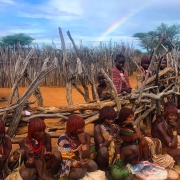
Photo credit: Zachary Garfield. Hamar women gather for a community meeting

– by Zachary Garfield

How do we resolve conflicts? Who helps resolve conflicts and why? To answer these questions, my colleague Luke Glowacki and I analyzed data from ongoing long-term fieldwork among Hamar pastoralists in Ethiopia’s Omo Valley, now published in Evolution and Human Behavior.

The Hamar are an interesting ethnographic case study for conflicts and their mediation. They live in the culturally diverse Omo Valley, home to over a dozen distinct ethnic groups, most of which practice pastoralism to some degree. There’s also much history of inter-group conflict, warfare, and large-scale cattle raids between these groups. So, ethnic identity is powerful. Most men over 50 have fired rifles at neighboring groups when herding cattle, and several have killed other men in the context of inter-group raids. Inter-group threats are assumed to help sustain within-group cooperation and, by extension, theoretically, limit within-group conflicts. Alternatively, it could be argued that cultural values favoring warriors and ferocity could lead to elevated potential for aspiring or well-known warriors to increase or maintain their status through competitive displays, creating additional opportunities for within-group conflicts.

Hamar society, like most East African pastoralists, is clan-based, and birthright membership in a patrilineal clan is a salient feature of one’s social identity. This is part of what makes what is called a kinship-intensive society. Clan-based societies have long been thought to be more likely to experience large-scale conflicts (and this has been recently demonstrated empirically), given that disputes between individuals from different clans or social groups can move up the social levels, recruiting substantially more significant numbers of engaged individuals with every ratchet up. “Me against my brother, me and my brother against my cousin, me and my cousin against the world,” the old proverb goes. This might be somewhat equivalent to, say, if, during a friendly football match between RasenBallsport Leipzig and Toulouse Football Club, an overly enthusiastic Toulousian and Leipziger got into a drunken brawl, which, if left unresolved, was likely to lead to a more significant conflict between the Saxony and Occitanie regions, and then an all-out war between Germany and France. Thankfully, as we all know, this is extremely unlikely to happen (especially in post-industrialized and Western cultural contexts). In kinship-intensive societies, however – which were probably the norm throughout our evolutionary history and remain common in many parts of the world today –  an open question is, how do clan-based social structures promote or inhibit conflicts between individuals?

Our study asked 99 adults, all willing participants in one Hamar community, to report on conflicts they had experienced with other adults, disputes between different community members they were aware of, or which they had been involved in as a third-party mediator. We also asked each participant to report on the nature and cause of the conflict, who was involved and their relationships, how relatively severe the conflict was, and the outcomes of the conflict, i.e., was it resolved and do the people in conflict get along today. Based on these data, we could analytically explore the socio-ecology of disputes and their mediation in this particular Hamar society.

A first and intriguing result: we observed that 54% of conflicts reported involved the intervention of a third-party mediator. This figure intriguingly aligns with findings from other autonomous, subsistence-based societies worldwide. For instance, von Rueden’s 2022 research with the Tsimane horticulturalists in the Bolivian Amazon demonstrated that, across four villages and seven observations, men reported the involvement of a third-party mediator in 56% of conflicts. Likewise, Singh and Garfield’s 2022 study with the Mentawai horticulturalists in Indonesia revealed that, out of 217 disputes, nearly half (49.8%) involved third-party mediation. These parallel findings across varied cultures and methods—from self-reports to observations—underscore a common thread: almost half of all interpersonal conflicts within these communities see the peacemaking hand of a third-party mediator.

We also found that pastoralists’ economic systems powerfully shape inter-individual conflicts. More than half of all reported conflicts were related to livestock grazing in someone’s agricultural plots or due to some other livestock management issue. Social disputes, such as those that arise from intoxication, quarreling children, or personal insults, were relatively more common among women, which we interpret as a consequence of gendered divisions of labor, more significant social interactions among women, and demographic patterns of greater mobility among younger adult men. Overall, these results paint a picture of a society where economic, social, and personal dimensions strongly interlace in the emergence of conflicts.

One of the most striking findings was the active involvement of both men and women in conflicts and their resolution, albeit in varying capacities. Men were more likely to be involved in economic and resource-based disputes, whereas women were more likely to be involved in resolving social conflicts. Furthermore, men are typically the mediators of disputes between other men; the same goes for women. However, conflicts between a man and a woman were equally likely to be mediated by a woman or a man. This highlights not only the significance of gender dynamics in conflict resolution but also the nuanced roles women play in these processes, even in a predominantly patriarchal society.

We also found that third-party mediation is more likely for social conflicts and when conflicts emerge between clan members but less likely for disputes between blood relatives. Surprisingly, more severe conflicts were not more likely to involve third-party mediation once other factors were considered. This emphasizes the importance of maintaining social cohesion within clans and suggests blood relatives may more easily be able to resolve conflicts on their own.

This study is just one small piece of the puzzle of human conflicts and resolution. Our results suggest that social structures can be designed to help limit and effectively mediate interpersonal disputes and that we should consider the social, economic, and cultural contexts of human groups and societies to understand what drives conflicts’ emergence and facilitates their resolution.

Read the original article here: Garfield, Z.H., & Glowacki, L. (2023). Interpersonal conflicts and third-party mediation in a pastoralist society. Evolution and Human Behavior, 44(6), 613-623.

To learn more about our work, our nonprofit, and philanthropy in Southwest Ethiopia, see The Omo Valley Research Project.