HBES 2025 Conference Survey Results

HBES Members,

I am writing in my capacity as Communications Officer to share with you survey results about our recent meeting in Atlantic City.

We had 127 responses, most of whom are faculty at various career stages, doctoral students, and postdocs. The vast majority of survey participants are from North America. Anthropologists and psychologists made up over 100 of the 127 responses, with psychology outnumbering anthropology three to one.

Here are statistical summaries of Likert scale questions, ranked from most satisfied to least satisfied

  • 83% (65/78) of participants agreed or strongly agreed that they felt free to express their views about scientific topics and questions at the 2025 meeting.
  • 82% (86/105) of participants are satisfied or extremely satisfied with the science in our journal, Evolution & Human Behavior.
  • 76% (80/105) of participants are satisfied or extremely satisfied with the degree to which HBES provides an environment in which people are free to express their ideas, opinions, or beliefs.
  • 76% (80/105) of participants are satisfied or extremely satisfied with the claim that HBES provides an environment in which people have an opportunity to excel regardless of their identity or background.
  • 70% (73/104) of participants are satisfied or extremely satisfied with the HBES e-newsletter. (As this is my first newsletter, I can take no credit, but would like to take a moment to thank my predecessor, Pat Barclay, for many years of service to HBES in this role.)
  • 70% (73/104) of participants are satisfied or extremely satisfied with HBES e-mail communications.
  • 65% (65/101) of participants would like to or are planning to attend HBES 2026 in Rabat, Morocco.
  • 62% (64/104) of participants are satisfied or extremely satisfied by the society’s overall impact.
  • 60% (62/102) of participants are satisfied or extremely satisfied with the Executive Council leadership over the last year.
  • 59% (61/103) of participants are satisfied or extremely satisfied with the disciplinary diversity of HBES.
  • 57% (58/102) of participants are satisfied or extremely satisfied by the society’s transparency of operations.
  • 54% (56/102) of participants are satisfied or extremely satisfied with the HBES website (33 participants are neither satisfied nor dissatisfied).
  • 40% (42/102) of participants are satisfied or extremely satisfied with HBES social media (another 42 participants are neither satisfied nor dissatisfied).
  • 26% (26/100) of participants are satisfied or extremely satisfied with the contractual agreement with Elsevier for our society journal, *Evolution & Human Behavior*.

In a large and diverse society, we can’t expect consensus on most issues. That said, most survey participants are broadly satisfied with the society.

There were two items in which a plurality of participants were neither satisfied nor dissatisfied: social media and the contractual agreement with Elsevier for Evolution & Human Behavior. (I’ll note that on no item was there a plurality, let alone a majority, who were dissatisfied or extremely dissatisfied.)

I cannot speak to any concerns you have about the contract with Elsevier, but as Communications Officer I am happy to relay any messages to the Executive Council. Social media, however, is within my purview as Communications Officer. Please send me concerns you have and suggestions on how we can improve this aspect of our society (same goes for the website, the newsletter, email communications. etc.).

Lastly, I’d like to highlight some of the qualitative opinions members shared with us. Rather than reproduce multiple responses verbatim, I’ll share with you my summaries.

  • A few participants expressed feelings of being an outsider, whether that’s because of their academic discipline (i.e. not being an anthropologist or psychologist) or their academic home (e.g. not being from a “respected lab”, a “California school”, or an “R-1”). This is unfortunate and certainly not something the society encourages. The EC is planning on adding events to the next annual meeting to try to address this issue.
  • A few participants complained that the society has become “too political”, with roughly equal numbers worrying it was too left-wing and too right-wing. The EC strives to maintain an environment in which HBES members are free to express themselves. This means that some members end up saying things that others deem “too political.” (I will also note that roughly the same number wrote lengthy responses commending the society for fostering an inclusive environment that allowed people to express their ideas. Furthermore, 80% of participants thought the society was doing a good job with freedom of expression and 83% felt they could express their ideas without a problem.)
  • A few participants felt that psychology is over-represented and anthropology is underrepresented. Among survey participants, psychologists did, in fact, outnumber anthropologists three to one. The EC remains committed to fostering disciplinary diversity. For example, plenary lectures tend to be balanced between psychology and anthropology. (I’ll also note that this is not a long-standing issue and that our society has very little representation outside these two disciplines—something we may want to work on in the future.)

Please reach out to the society if you feel your opinions are not being heard.

If you have specific suggestions on how we might improve our society, feel free to email me (communications@hbes.com) and I will relay the message to the Executive Council.

If you witnessed or experienced inappropriate behavior at conference , please contact the Grievance Committee (https://www.hbes.com/grievance/).

Sincerely,
Karthik Panchanthan

Postdoc focusing on interdependence and cooperation – University of Arizona

Dear colleagues,
I wanted to circulate an opening for a postdoctoral position, and would like to kindly ask that you share this opportunity with grad students who may be interested in working with me on topics related to interdependence and cooperation. I will also be reviewing graduate student applications this cycle, and would be grateful if you shared this information with undergraduate students with an interest in emotions, interdependence, and cooperation. Thank you for your time.
Postdoc position. The SPECIEs (Social Psychology of Evolutionary Cooperation, Interdependence, and Emotions) Lab in the psychology department at the University of Arizona is hiring a Research Scientist (i.e., postdoctoral scholar). This is a 3 year position at $65k/year (yearly contracts with renewal). The postdoc will be involved in the analysis of existing field data on cooperation and well-being among the Mayangna of Nicaragua, help in the design and development of new projects (e.g., experiments, large-scale cross-cultural surveys, ecological momentary assessment), and conduct fieldwork in the Bosawas biosphere reserve of Northern Nicaragua during two field visits, each lasting 1-3 months. Therefore, the candidate must be fluent in Spanish, and willing to conduct fieldwork in a remote area (i.e., no basic services like water, sewage, electricity, etc.). The researcher will also collaborate on ongoing projects, gain mentorship, and professional development. The ideal candidate has strong skills in statistics (e.g., SEM, multi-level models, longitudinal data, social networks), data visualization, and is knowledgeable in the science of cooperation/prosocial behavior, the evolutionary human sciences, and/or affective science.
Start date: Summer-Fall 2026.
Review of applications: until filled.
Application materials: 1-2 page cover letter, CV, 2-3 reference contacts (email and phone number).
Contact: Diego Guevara Beltran at dguevarabeltran@arizona.edu
For an overview of current/ongoing research see: https://psycheddiego.mystrikingly.com/publications
Best,
Diego Guevara Beltran, PhD
Assistant Professor
Psychology Department
University of Arizona

Biological Anthropology Faculty Hire – University of Minnesota Twin Cities

UMN Search for a Biological Anthropologist in 2025-2026

About the Position

The Department of Anthropology in the College of Liberal Arts at the University of Minnesota, Twin Cities invites applications for a full-time, tenure-track position in paleoanthropology beginning fall semester 2026. We seek scholars at the cutting edge of biological anthropology who critically utilize scientific approaches, broadly conceived, to answer anthropological questions related to the evolution and variation of humans and/or hominin ancestors. Possible research areas include hominin fossil record and skeletal anatomy, biomechanics and functional morphology, or evolutionary approaches to the study of human adaptations. Appointment will be 100% time over the nine-month academic year (late August to late May). The appointment will be made at the rank of tenure-track Assistant Professor, depending on qualifications and experience, and consistent with collegiate and University policy. 

Faculty in the Department of Anthropology in the College of Liberal Arts are expected to maintain an active program of scholarly research or creative activity that includes publications; teaching undergraduate and graduate level courses; advising students; pursuit of extramural funding; and service effort appropriate for the level of appointment to the department, college, university and profession. The holder of this position is expected to teach two courses per semester, which includes joining the teaching rotation for a large introductory course in biological anthropology, as well as developing specific undergraduate and graduate courses in the candidate’s area of expertise. We are especially interested in candidates who, broadly conceived, enhance diversity in the department and whose interests integrate with and expand on current department expertise in biological anthropology, and can interface with the four fields of anthropology. 

The Standards for Promotion and Tenure in the Department of Anthropology are available at: https://faculty.umn.edu/sites/faculty.umn.edu/files/anthropology.pdf 

The Workload Principles and Guidelines for Regular Faculty in the College of Liberal Arts are available at https://neighborhood.cla.umn.edu/college-knowledge/workload-principles-and-guidelines

State law requires a good faith estimate of the salary range for all advertised positions. The range for this position is $75,000 to $150,000, depending on discipline, experience and other considerations. Faculty positions also include significant start-up funds, as well as retirement, health and other benefits. 

Qualifications

Required Qualifications: A Ph.D. in anthropology or closely related field is expected to be in hand at the time of the appointment.

Preferred Qualifications: Evidence of research – including postdoctoral or equivalent post-degree experience – in biological anthropology, specifically of paleoanthropology, functional anatomy, or similar.

Candidates will be evaluated according to the overall quality of their academic preparation, the strength of their research and its relevance to the department’s academic priorities and the field of inquiry, evidence of commitment to teaching and skills as a teacher, and the quality of recommendations. The successful applicant will have a strong commitment to contribute at all levels of our undergraduate and graduate programs.

How to Apply

The priority deadline for application materials is October 17, 2025. This position will remain open until filled. Applications must be submitted online. To be considered for this position, please click the Apply button and follow the instructions for completing an application.

Required documents must be attached by accessing your “My Job Applications” page and can be attached after submission of the application by exiting and re-entering the Job Center, accessing your “My Job Applications” page, and uploading documents there. The following materials must be attached to your online application: (1) cover letter; (2) curriculum vitae; (3) research statement; (4) teaching statement; (5) and names, addresses and email contact information for three references as a separate attachment in “My Job Applications.” Additional materials may be requested at a later date.

Questions may be addressed to search committee chair Michelle Brown [brow7100@umn.edu].

Studying the rarity of collective music-making in four indigenous societies

– by Dor Shilton, Aniruddh D. Patel, Kim Hill, and Chris von Rueden

Many think that music evolved to promote or signal social cohesion. However, there are several societies in which group singing and dancing are extremely rare. Why is that the case, and what does it mean for our theories of music evolution? We examined four indigenous societies in which collective music-making is rare, assembling evidence concerning three non-mutually exclusive hypotheses:

  1. Collective action hypothesis: collective music-making is less likely where there is less collective action in general
  2. Musical expertise hypothesis: collective music-making is less likely if music is normally performed by people with special expertise or used to signal individual status
  3. Musical style hypothesis: collective music-making is less likely if the predominant musical styles are less suitable for coordinated singing and dancing

Our case studies

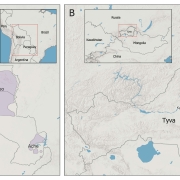
Using previous cross-cultural studies, we narrowed in on societies in South America and Siberia:

  1. the Tsimane of lowland Bolivia
  2. the Ache of eastern Paraguay
  3. the Ayoreo of Bolivia and Paraguay
  4. the Tuvans of the Russian Republic of Tyva

We aimed to create a detailed portrait of each society and its music-making practices using both ethnographic materials and first-hand reports. The latter were essential, since music-making practices are often not a major focus of ethnographies — especially in cultures in which music is not a central feature of collective behavior. Two of our co-authors had extensive relevant knowledge: Chris von Rueden, who worked with the Tsimane since 2005, and Kim Hill, who worked with the Ache from 1977 to 2020. We also corresponded with over a dozen anthropologists and other people familiar with these societies.

In the process of assembling these portraits, we became cognizant of the diverse histories underlying each culture and its musical customs. We did, however, find some convergent evidence for our hypotheses.

Collective action

This was the best supported hypothesis. In all the societies we examined, collective action related to subsistence was mostly limited to small groups and extended families, inter-tribal warfare was either non-existent or limited to small parties, and collective religious action was either suppressed significantly (limiting the scope of attendance) or was altogether absent.

Musical expertise

The influence of expertise was supported only in relation to religious activity. Among the Tsimane, Ayoreo, and Tuvans, the songs involved in religious rituals are potent and potentially dangerous, and require a level of expertise and knowledge.

Musical style

While we found evidence of solo-oriented musical styles (drone-overtone singing, ad-libbing), cases like the Tuvans made it clear that these do not prevent other singing styles from being used when circumstances encourage people to sing together. We therefore concluded that musical style is the consequent rather the antecedent of collective music-making prevalence.

Cultural loss

Cultural loss is a factor we haven’t initially considered, but which surfaced as a result of our study. Whether religious practices were suppressed by external forces (which is the case with the Tsimane, Ayoreo, and Tuvans), or were lost along with other cultural traits (as is the case with the Northern Ache), it certainly seemed to influence the overall prevalence of collective music-making.

Key Takeaway

Overall, our findings suggest that the scale and religiosity of collective action may be the most important explanatory factors for the prevalence of collective music-making, but other factors, like cultural loss and religious expertise, also play a role. While collective music can benefit social well-being, it is evidently not essential, as the four societies we studied sustained many key aspects of their social life with little to no collective music-making. One important takeaway from this study is that music evolution theories need to look more deeply into the relationship between music and religion, which could turn out to be a big part of the puzzle.

Finally, we invite readers to listen to some of the songs of the Tsimane, Ache, and Tuvans:

  1. A female Tsimane singer (link), from McDermott, J. H., Schultz, A. F., Undurraga, E. A., & Godoy, R. A. (2016). Indifference to dissonance in native Amazonians reveals cultural variation in music perception. Nature, 535(7613), 547–550. https://doi.org/10.1038/nature18635
  2. Northern Ache songs (link), from Singh, M., & Hill, K. (2025). Loss of dance and infant-directed song among the Northern Aché. Current Biology. https://doi.org/10.1016/j.cub.2025.04.018
  3.  An album of Tuvan singing (link), audio companion to Levin, T. (2010). Where Rivers and Mountains Sing: Sound, Music, and Nomadism in Tuva and Beyond (PAP/COM edition). Indiana University Press.

Read the original paper here: Dor Shilton, Aniruddh D. Patel, Kim Hill, Chris von Rueden. (2025) Why collective music-making is sometimes rare: A study of four indigenous societies. Evolution and Human Behavior, 46(4), 106695.

Too Many Preferences, Too Little Evolution: Multivariate Mate Choice and the Limits of Mate Preference Evolution

– by Kaitlyn Harper

As evolutionary psychologists, we love a good story about sexual selection. They usually go like this: humans have evolved to prefer a given trait (e.g. intelligence, facial symmetry, waist-to-hip ratio) because it offers an evolutionary benefit, either directly or indirectly. Over time, people who prefer and therefore mate with partners who have these advantageous traits are more likely to pass on their genes and as a result these preferences become more and more common. Trait confers fitness benefit to partners. Corresponding mate preference evolves. Everyone goes home happy. But there’s a key assumption in this narrative that’s often taken for granted: that people actually end up with partners who match their preferences. And that’s where things start to get messy.

Empirical research paints a more complicated picture. Across many studies, the link between what people say they want in a partner and who they actually choose tends to be surprisingly weak. In many cases, preferences simply don’t map onto real-world mate choices. This inconsistency creates a fundamental tension: how can mate preferences be driven by sexual selection if they don’t consistently guide mate choice in reality? One suggested approach to reconcile this inconsistency is to consider mate choice as a multivariate process. That is, people aren’t picking partners based on a single trait, they’re juggling many preferences at once, making trade-offs in the process. This means that any single preference might only have a small effect on mate choice in reality, swamped by other competing criteria. It’s a tidy solution: mate preferences which have been observed in isolation can still exist, but diluted effect sizes could explain the lack of observed association between preferences and partner outcomes in more realistic settings. But this raises another important question: if the effect of each preference on partner choice is so small, are they still visible to selection?

To test the multivariate limits of the classic sexual selection narrative, we built an agent-based model that simulates a population of individuals who choose mates based on heritable traits and preferences and pass on these genes over 100 generations. We asked an overlooked but crucial question: what happens to mate preference evolution when individuals are choosing partners not just based on one or two preferences, but up to ten? Does increasing multivariate trade-offs in mate choice weaken the evolution of preferences? We ran the model under two scenarios – one where preferences evolve through indirect selection (i.e. fitness benefits are conferred through good genes passed on to offspring), and one where we added direct selection (i.e. fitness benefits are also conferred immediately through fertility benefits).

The results, which we unpack further in our full article, revealed that as the number of preferences used in the model increased, the evolution of those preferences slowed dramatically. With just one or two preferences, the model worked much like classic sexual selection theory predicts, where preferences and traits evolved hand-in-hand. But once we asked agents to consider many preferences, things started to break down. Trait evolution was largely unaffected, but preference evolution hit a wall. In our models, once mate choice involved ten preferences, indirect selection barely moved the needle of preference evolution. Direct selection held up better, proving more robust under the multivariate constraints.

So, what do our findings mean for the way we think about human mate preference evolution? They suggest that the heavily relied on approach, where each mate preference is assumed to have evolved by offering unique indirect fitness benefits, needs to be reconsidered given the many human mate preferences that have been observed. That’s not to say that these observed preferences aren’t real, or that they didn’t evolve – it just means the standard one trait, one fitness benefit, one preference approach may not hold up in the context of multivariate mate choice. Instead, we may need to consider alternative frameworks: perhaps preferences reflect mostly direct benefits, function as redundant signals, or arise from cognitive mechanisms. One idea is that only a few core preferences – such as for health, status, or resources – are truly evolved, while the traits we find attractive are indicators of these broader qualities that we learn implicitly via associative learning (e.g. finding clear skin attractive because we’ve subconsciously learned it is a signal of health).

Ultimately, our findings invite a rethinking of the classic sexual selection story, urging us to zoom out from individual preferences and develop more comprehensive models that reflect the multivariate nature of mate choice.

Read the original paper here: Harper, Kaitlyn T., & Zietsch, Brendan P. (2025) Multivariate mate choice constrains mate preference evolution. Evolution and Human Behavior, 46(4), 106694.

Debt beyond money: how borrowing triggers our social emotions

— by Maria Brackin

Neither a borrower, nor a lender be;
For loan oft loses both itself and friend,
And borrowing dulls the edge of husbandry.

– William Shakespeare, Hamlet

Suppose that you borrow money from a friend and you promise to repay them soon. Wait, you might be thinking, you would never do this! You would avoid having to borrow—for instance, by saving money, or delaying whatever purchase you were planning. This may be the case, but a majority of people in the world do borrow informally, whether by choice or necessity.

Entertain me for a moment and imagine this is really happening. If the thought of borrowing makes you feel uncomfortable, you’re not alone. In a theoretical, economic sense, borrowing is a straightforward, amoral transaction—the only details that should matter are the willingness of the lender to give you the money, and the terms of repayment. If your friend is offering, and you are confident that you will repay, why worry?

But worry we do. Borrowing can prompt a range of different emotions: relief and gratitude towards the person who is loaning you money, anxiety and guilt about your debt to them, and a gnawing awareness that there is now an imbalance between you. Research suggests that, understandably, informal debt damages social relationships when loans are not repaid, but even the act of borrowing itself has varied outcomes: interpersonal conflict and negative emotions on the one hand; stronger relationships and positive feelings on the other.

Your next thought might be that you need more information: why are you borrowing the money? From which friend? Context is essential, and your emotional reaction will likely depend on what you imagine the situation to be: borrowing from a rich friend feels different than borrowing from a poor friend, and borrowing to meet an urgent need feels different than borrowing to purchase something unimportant.

In our recent paper, Hugo Mercier and I point towards a potential explanation for such emotional reactions. Our core claim is that informal, interpersonal borrowing is not just an economic transaction, but a social interaction. As humans, our cognitive systems are highly attuned to fairness in our social lives—this is why we keep track of how people behave towards us and others, and the consequences of their actions.

When we borrow, we risk not just our wallets but our reputations. The strong feelings that emerge include “social emotions” that have evolved to regulate interpersonal relationships, such as gratitude, guilt, anger and shame. These emotions all respond to the welfare tradeoff ratio (WTR): the costs we feel we should pay to benefit someone else, or the costs we feel they should pay to benefit us. In the case of borrowing:

  • A loan that imposes too high a cost on the lender (such as taking money that they have specifically set aside for something else), or delivers too low a benefit for the borrower (such as a frivolous purchase), is indicative of a low WTR and can generate emotions such as guilt (if we are the borrower) and anger (if we are the lender).
  • A loan that imposes only a low cost (such as borrowing from someone with money to spare), or delivers a high benefit (such as an essential purchase), suggests a high WTR, causing positive emotions like gratitude.

In a series of online experiments, we asked participants to imagine, as you just did, that they had borrowed money from a friend, or that they had loaned money to a friend. We provide the crucial context outlined above: the costs to the borrower or the benefits to the lender. In the first study, we measured social emotions for both lenders and borrowers, comparing high and low benefits and high and low costs. In the second study, we measured the change in social emotions after contextual information about the loan was revealed. In the third study, we measured social emotions and repayment intention, relative to two potential lenders.

In the first study, we found that people emotionally respond to welfare tradeoffs in interpersonal borrowing scenarios. For a huge majority of participants, emotions tracked the WTR: they anticipated higher negative emotions (guilt, shame, anger) when the benefit to the borrower was low or the cost to the lender was high, and higher positive emotions (gratitude) when the benefit to the borrower was high or the cost to the lender was high.

The second study explored indebtedness in the context of social emotions. We found that negative emotions (guilt) related to borrowing increased significantly more when the benefit of the loan was revealed to be low rather than high, while positive emotions (gratitude) increased more when the benefit was revealed to be high. Indebtedness increased in both situations, suggesting that it can be triggered by increases in either positive emotions or negative emotions.

In the final study, we found initial evidence that welfare tradeoffs influence not just emotions, but actual borrowing choices. When comparing two potential lenders, participants expected to feel more of all the social emotions (both positive and negative) when the lender asked for nothing in return (besides repaying the loan). These stronger emotions were linked to a curious choice: nearly a third of participants preferred to take on a loan from the other lender, who asked for a favor in addition to repayment, presumably to avoid anticipated negative emotions like guilt.

Despite how common informal borrowing is, it is little-studied compared to formal credit from banks or microfinance institutions. More research is needed in this area. Studying a wider range of cultures is particularly important: if borrowing activates our evolved cognitive systems, we would expect to see cross-cultural similarities in emotional responses. Future research might also explore the role of social emotions in formal borrowing. Most of the evidence about emotional reactions to borrowing comes from surveys about bank loans, with people reporting strong feelings that are linked to social context and responsibility. If social emotions also emerge in the context of formal credit, this suggests that social and reputational concern represents an additional, unappreciated element of financial inclusion.

Read the original paper here: Brackin, M., & Mercier, H. (2025). Owing others: debt, welfare tradeoffs, and the social emotions. Evolution and Human Behavior46(4), 106690.

Assistant Professor in Traditional Ecological Knowledge – Stanford

We seek applicants for a tenure-track appointment at the assistant professor level in the Stanford Doerr School of Sustainability in the field of Traditional Ecological Knowledge (also referred to as Indigenous and local knowledge, Indigenous science, Native science, and other similar terms) and its relevance to social and environmental sustainability. Topical research areas of interest include, but are not limited to: the role of fire and other aspects of Indigenous land stewardship in the changing climate; establishment and management of natural protected areas; conservation and application of the wild relatives of crops and animals; the ethical and responsible collection and use of socio-ecological data; environmental governance; the role of tribal food and land sovereignty and cultural revitalization for environmental sustainability; and two-eyed seeing, the multicultural approach to understanding the natural world using both Indigenous and Western sciences as independent, but complementary, ways of knowing.

The range of expertise and facilities across Stanford University’s main campus, as well as Jasper Ridge Biological Preserve (‘Ootchamin ‘Ooyakma) and Hopkins Marine Station, provide opportunities to develop a research program that bridges Indigenous and Western knowledge systems.

For more information, visit the link below:
https://facultypositions.stanford.edu/en-us/job/494875/assistant-professor-in-traditional-ecological-knowledge

Two Faculty Positions in Biological Anthropology – The University of Western Australia

The University of Western Australia is hiring for two faculty positions

  • Lecturer in Biological Anthropology
  • Associate Professor in Biological Anthropology

The School of Human Sciences is a multi-disciplinary School with expertise in Anatomy, Physiology, Human Biology, Sport Science, and Exercise Health.

The School is one of the largest in the University and offers a highly populated Major in Anatomy and Human Biology, and a Minor in Biological Anthropology. Biological Anthropology encompasses evolutionary demography, genetics, and behavioural ecology of humans and non-human primates, with a focus on health, disease, and conservation.

The School manages a very productive research program, supervising Honours, Masters and PhD students. The breadth of research and researchers can be explored further on our webpage.

In these teaching-research position, you will be expected to make a strong contribution to the School’s teaching and research portfolio in Biological Anthropology.

Key Responsibilities

  • Contributes to outstanding teaching and learning outcomes
    • Contribute to world-class teaching in the degree programs of the School at both Undergraduate and Postgraduate levels; undertake administrative duties as required
    • Contribute and commit to high quality teaching and unit coordination
    • Attract and recruit quality postgraduate students
    • Design and implement best practice assessment of student learning outcomes and participate in assessment panels
  • Contributes to research outcomes within discipline or area of expertise
    • Join or develop a research team to initiate research in local, national, and international arenas Undertake independent and collaborative research to generate research outputs of high impact
    • Communicate research findings through scientific publications, reports, meetings, and teaching
    • Enhance the reputation of the School and the University by producing publications in highly ranked, peer reviewed, journals of international standing
    • Either as an individual or as part of a team, play a role in bids for major research funding from national and international competitive funding agencies, industry, and government partners
  • Service and Engagement
    • Contribute to the governance and collegial life within the School, across the University, and more broadly outside the institution
    • Work within the legislative requirements of the University and support the University’s commitment to inclusion and diversity
    • Represent the University of Western Australia through involvement in professional associations, conferences, non-academic (e.g. government, not-for-profit, industry) partnerships, and other external activities
    • Maintain knowledge of standards of practice and required procedures for student assessment and policy, and ensure that these are completed to required standard and within an acceptable time frame
    • Undertake administrative duties as required in relation to teaching and research supervision
    • Perform other duties as directed by the Head of School and the Head of the Department of Anatomy, Physiology and Human Biology

Selection Criteria

  • Qualifications and/or certifications
    • PhD in an academic field relevant to the discipline
  • Teaching and learning
    • Capacity to teach human behavioural ecology
    • Demonstrated ability, relative to opportunity, to deliver high quality teaching approaches, assessments, and materials for units and courses
    • Demonstrated commitment to inclusive teaching practices to extend equality of opportunity for all learners
  • Research
    • A demonstrable track record, relative to opportunity, of excellence in research, as evidenced by peer-reviewed journal articles published in high quality journals
    • A demonstrable track record, relative to opportunity, of successful applications for competitive funding
    • Demonstrate evidence, relative to opportunity, of successful supervision or co-supervision or mentoring of HDR or Honours students
  • Service/ Engagement
    • Demonstrated ability to relate well to staff and students at all levels, and evidence of a commitment to equity and diversity principles
    • Demonstrated ability to positively contribute to team, school and wider University activities such as team and school meetings, strategic planning, and program development
    • Demonstrable experience, relative to opportunity, of participation in education/research leadership in public engagements that promote research and/or education outcomes, including engagement with government and industry

The deadlines for these positions are August 22 (Associate Professor) and August 29 (Lecturer).

For more information, click on the links below:

Royal Society Publishing Competition 2025

Are you a scientist with an interest in photography? We’re delighted to announce that the Royal Society Publishing Photography Competition is now open for entries until 15 August 2025 for a chance to win £1000! The competition celebrates the power of photography in conveying the wonder of science happening all around us and photographs can be submitted in the categories of: Astronomy, Behaviour, Earth Science and Climatology, Ecology and Environmental Science, and Microimaging.

The competition is free to enter and open to anyone studying or working in science at graduate level or above. Category winners will receive a one-year membership to the Royal Photographic Society and the overall winner will receive a grand prize of £1,000. Find out more: https://bit.ly/RSPphotocompDES9271_4_Publishing photography competition 2025_QR poster_A4.