
Revisiting Man the Hunter
– by Haneul Jang
For decades, the phrase Man the Hunter has occupied a central place in discussions of human evolution.
Today, however, the phrase sounds outdated, evoking a familiar image of men hunting large game while women gathered plants and cared for children. The phrase is often seen as representing overly simplistic and male-centered evolutionary theories.
So why would a diverse group of contemporary anthropologists want to revisit it?
That question sits at the center of our recent paper published in Evolution and Human Behavior. In the paper, we ask what Man the Hunter (hereafter, MTH) has actually meant over time, and why the idea has remained so influential and so persistently debated for decades.
Our author team brings together anthropologists working across ethnography, archaeology, evolutionary theory, psychology, and human behavioral ecology, studying past and present hunter-gatherer societies. We approached MTH from different perspectives, reflecting the broader range of approaches that now shape research on human evolution. My own work focuses on women’s foraging and cooperation among Bayaka hunter-gatherers in the Congolese rainforest, which shaped the way I think about subsistence, cooperation, and human evolution.
What Does Man the Hunter Really Mean?
What we found is that MTH was never just one thing.
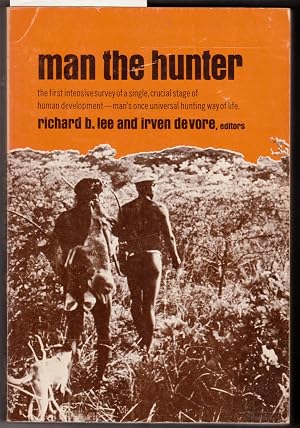
The term has referred to both an evolutionary framework and a broader cultural narrative about human nature itself. Many discussions of MTH collapse several distinct meanings together: the original 1966 Man the Hunter conference and edited volume, popular portrayals of hunting-centered evolution, and debates within human behavioral ecology about hunting, gathering, and the division of labor in human societies. Distinguishing among these meanings and contexts helps explain why the debate has persisted for so long.
But perhaps more importantly, the debates surrounding it inspired many research programs that later expanded and revised it, including research on cooperation, food sharing, subsistence practices across past and present societies, and the ecological and social factors shaping divisions of labor.
In other words, the history and legacy of MTH are more complex and more scientifically productive than they are often portrayed.
Hunting Was Important, but Never the Whole Story
Early anthropologists studying hunter-gatherers were understandably fascinated by hunting. Hunting is dramatic, risky, and highly visible. Large-game hunts demand coordination, planning, technological skill, and food sharing, all deeply relevant to understanding human evolution. As a result, hunting became central to many theories about how humans evolved.
But even in the early discussions, it was clear that hunting was rarely the only source of food. At the Man the Hunter conference, the importance of plant foods and women’s gathering was already emphasized. Gathered foods provided a substantial, and often dominant, portion of daily calories, while the balance between hunting and gathering varied across ecological settings.
In other words, debates about women’s subsistence labor and the diversity of foraging economies were not external critiques added later. They were already part of the scientific discussion surrounding MTH.
Yet this broader picture was often reduced to a much narrower image of ‘men evolved by hunting’.
Over time, this stereotypical image was increasingly challenged. Archaeologists and ethnographers documented more flexible divisions of labor than earlier theories suggested. For example, research among Agta hunter-gatherers in the Philippines documented women hunting with bows and arrows, while work among Aka foragers in the Central African Republic documented simultaneous cooperative labor and childcare among men and women. Across societies, both women and men contribute to subsistence in flexible and complementary ways, and women’s labor has long played a central role in household provisioning. Childcare, food processing, and food sharing are also recognized as central to understanding human evolution. Importantly, many of these findings emerged from the same questions that originally motivated interest in hunting: how humans cooperate and survive in challenging environments.
Human Cooperation Beyond Simple Divisions of Labor
I have been studying cooperation among Bayaka women in foraging, childcare, and knowledge transmission, focusing on women’s central roles in subsistence and support networks that also involve children through age-graded learning and cooperation. From my perspective, one of the most productive outcomes of the MTH tradition was that it pushed anthropologists to think seriously about how people depend on one another in everyday life.
Why do people cooperate beyond immediate kin? How is food shared across households and generations? How are childcare, foraging, and provisioning coordinated within everyday social life?
These questions cannot be answered by focusing only on hunters or only on gatherers. Human subsistence systems rely on many interconnected forms of labor and support.
For example, successful subsistence often depends on broader systems of social support that include foraging, childcare, food processing, and food sharing. Both hunting and gathering require extensive ecological knowledge, planning, and coordination with other group members. The evolutionary success of humans likely depended not on one sex performing one heroic task, but on the ability of groups to flexibly combine many complementary forms of labor.
In this sense, revisiting debates surrounding MTH does not mean either glorifying or dismissing them. It means understanding how these debates inspired later research that broadened and reshaped earlier ideas about human evolution. Questions surrounding women’s labor and cooperation, which received relatively little attention in the original MTH discussions, motivated multiple lines of research on the importance of women’s subsistence work in evolutionary history. These questions also became central to research on childcare, provisioning, food sharing, and social interdependence, including influential work by scholars such as Sarah Blaffer Hrdy on cooperative childcare.
That is why reducing the conversation to “Was MTH right or wrong?” misses the larger issue. A more important question is how these debates pushed anthropology toward a broader understanding of cooperation, subsistence, and the many forms of labor that shaped human evolution. But to understand that legacy, we need to understand the historical context in which these debates developed.
By revisiting the history of MTH, our paper highlights how scientific debates about the past continue to shape the questions we ask about what made us human.

