
How social connections shape our willingness to take risks
– by Joon Hwang
Imagine you have two options: get $50 for sure or take a 50-50 chance of getting $100 or nothing. Both options have the same expected payoff ($50), but one might appeal to you more than the other. If you prefer to take that chance, you might be a risk-taker; if you prefer the guaranteed $50, you might be risk averse. You will notice that researchers use “risk” here to describe how much the possible payoffs vary, rather than harm or loss itself.
Now let’s add one more detail: you can count on family, friends, or neighbors to help you if you choose the risky option and get nothing. Would that make you more willing to take the risk? This is the question we examined in our recent paper in Evolution and Human Behavior. People have had to make decisions under risk throughout human history. Our ancestors could spend a day pursuing a large animal and return with plenty of meat or nothing at all. Today, someone might leave a steady job to start a business, hoping to earn more but knowing they could earn less or lose money.
Such unpredictability in everyday life is also closely linked to the evolution of human cooperation, particularly resource sharing. By sharing resources with others – giving when they have more and receiving when they have less – people can make their access to resources more reliable. The idea that sharing reduces variability of an outcome in this way has been widely studied under the “risk-reduction reciprocity” model of human cooperation. But in this study, we examined the decision itself. Having support to fall back on might do more than help you recover from a bad outcome. It might make you more willing to take a risk in the first place!
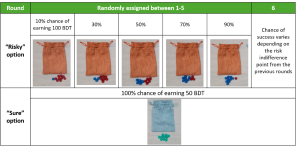
We worked with 140 adults from 82 households in Matlab, Bangladesh. In this rural area, farming and fishing, once the main sources of livelihood, have declined, while people’s dependence on markets and cash income has grown. The growing need for cash has made informal lending networks more important, while people continue to share food and household items with relatives and neighbors. We asked participants whom their households could borrow money (2,000 Bangladesh taka (BDT); about 21 USD), food, or household items from and whom they would lend to. From their answers, we mapped two social networks, with connections between households representing moneylending in one and the sharing of food and household items in the other. We also measured their willingness to take risks by asking them to choose between a guaranteed 50 BDT (about 0.52 USD) and a chance of getting 100 BDT (about 1.05 USD) or nothing, with the odds varying across rounds (see the figure below).
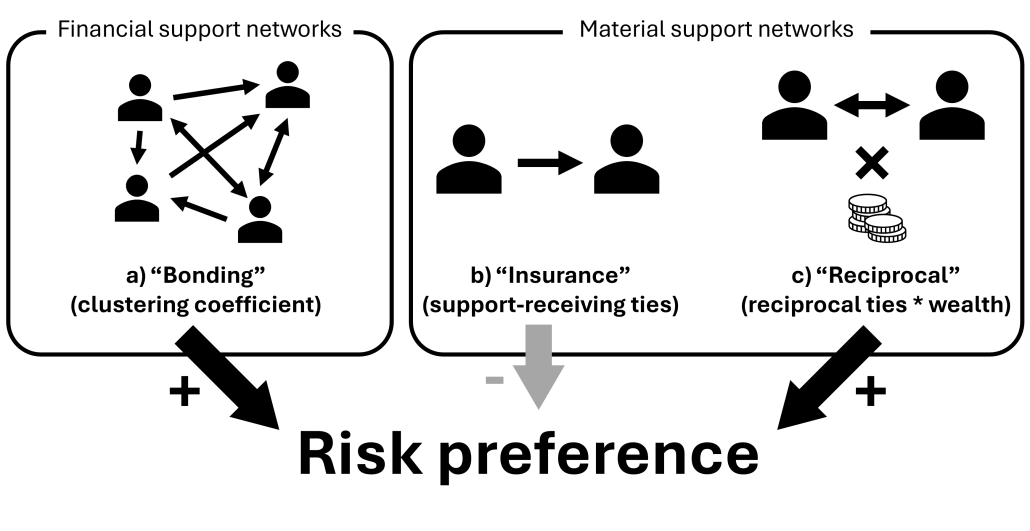
We found that different forms of social support were linked to greater or lower willingness to take risks, depending on the type of support and how people were connected. Participants were more willing to take risks when their households were part of tightly connected moneylending networks. This pattern is called “clustering”: the people you are connected to are also connected to one another. In moneylending networks, this could keep money circulating within a cluster. For example, money you lend to one household may later reach another household that can help you when you need it. Having financial support ties within this tightly connected cluster could help you cover a large expense or recover from a business loss. As a result, people may be more willing to take risks when they have reliable financial support to fall back on.
In contrast, participants who could turn to more households for food and household items were less willing to take risks. We had expected this support to encourage risk-taking too, but food and household items are worth less than cash loans and may not provide enough of a buffer against large losses. Instead, this support may act as informal insurance, helping people meet their everyday needs so they do not have to take risks out of desperation.
Although our results do not establish causal relationships, they help us consider how the social connections around us and the resources available through them might provide cues for responding flexibly to uncertainty. These cues may make a risky choice easier to afford (e.g., financial clustering) or reduce the need to take that risk at all (e.g., sharing food or household items). Seen this way, human systems for risk management may have evolved within networks of cooperation, where the structure of relationships shaped not only how resources were distributed to reduce variability in outcomes, but also how people made decisions under risk in the first place.
Should we worry, then, that helping people recover from losses might encourage them to take risks recklessly, a problem known as “moral hazard”? We suggest looking at it another way: innovation also involves risk, whether someone is trying a new farming method or starting a business. People may be more willing to try a new idea if others in their social networks can help cover the costs of failure, while the prospect of sharing in the gains through social networks may give those people a reason to offer that help. Thus, innovations we often credit to individual ingenuity may owe their success to the social environment that lets people take risks and recover from failed attempts. If so, we may also want to reconsider how the gains from successful innovations are shared, both to recognize that collective contribution and to sustain the cooperation that supports future innovation.

