
Possession is nine-tenths of the law – but maybe not for infants
– by Erik K. Fonn
One important aspect of our social world is that we have intuitions that specific people have stronger claims to specific objects. We often refer to this as ownership. Getting this right is likely adaptively important: Taking the wrong things might be dangerous, and people might start to dislike you for it. But getting ownership right is in principle also difficult because these intuitions often bear on things that happened in the past: that is, how and by whom something was acquired. For instance, whether a person took an object by force or bought it likely matters for our intuitions about whether the object belongs to that person. But past events like these are often unavailable to us. So how are we able to form intuitions about who owns what?
Many studies suggest that humans, at least from early childhood onwards, rely on some mental shortcuts in order to make these ownership ascriptions. One such shortcut is prior possession. Simply put, this is the rule that whoever apparently had a resource first gets to keep it. And there are good evolutionary reasons that this is so. For instance, a person buying a house might start furnishing it according to their specific needs and preferences, making the house more valuable to themselves but not necessarily more valuable to everyone else. In this case, the house owner would tend to be more willing to defend their house than others are willing to fight to take it, and this general pattern has been documented across a range of animal species. Moreover, because losing possessions to others is costly, people might avoid those who do not respect prior possession and choose others as social and cooperative partners. Among humans, being a part of a social group and reaping the benefits of cooperation is indeed important to survive and thrive.
However, very little is known about how this prior possession rule actually emerges in human development: Is it something we learn from experience, or does it perhaps depend on cultural norms? Another possibility, which we sought to test, is that the prior possession rule is present in infants before they have had extensive experience with conflicts and before they have learned much about the world through socialization. In other words, the prior possession rule might serve as a backbone of human social understanding helping us to make sense of and navigate the social world from earliest childhood. Indeed, previous research suggests that infants have a very sophisticated understanding of the social world: Long before they can talk, infants distinguish agents from objects, predict who will win conflicts, and figure out who belongs to which group. Do infants, then, use prior possession to make sense of their social surroundings?
We approached this question in two ways: First, we asked whether infants avoid those who take, or attempt to take, things from others. Second, we asked whether infants expect those who hold prior possession to retain this possession when challenged. In order to address the first question, we showed 10–13-month-olds live puppet shows of one puppet possessing a toy box and another who did not. Subsequently, the one who did not have a toy box challenged the other. We varied across participants whether the one who held first possession lost the object, retained it, or whether the conflict was left unresolved. Finally, we tested whether infants preferred either of the two agents: They were presented with the two puppets on a tray and were allowed to choose between them. Across all the experimental conditions, infants were just as likely to choose the prior possessor as the contender. In other words, infants did not appear to avoid those who violate first possession.
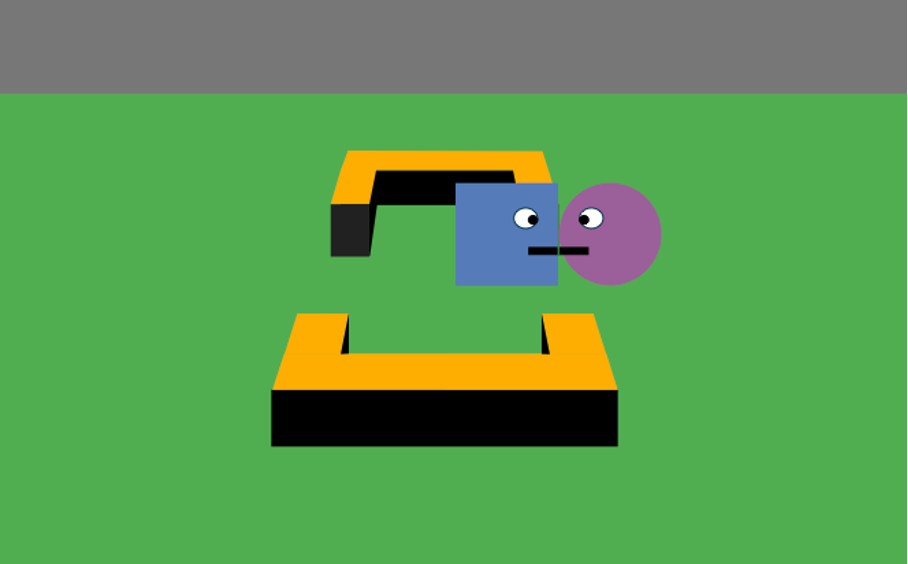
Although infants did not systematically evaluate these social scenarios, they may in principle still have expectations that first possessors will win. Across two experiments we showed infants aged 10–18 months videos of a prior possessor (standing in the middle of an enclosure) being challenged by a contender. Infants saw both outcomes: either the prior possessor won the enclosure, or the contender did. If infants expect prior possessors to win, they should be surprised and look longer at the videos where the contender wins the territory. However, across both experiments, we found no evidence that they did. Yet, infants were able to understand the conflict: When we changed the size of the agents, so that one agent was much bigger than the other, infants expected the larger individual to win. In other words, infants were able to understand what was going on in the videos, but they did not care about who held prior possession.
These results did not align with our hypothesis that infants would use prior possession to make sense of their social world. Specifically, while prior research suggests that infants are able to track possession history in certain ways, for example distinguishing giving from taking, our results suggest that infants do not yet have the intuition that prior possessors have a stronger claim.
Of course, absence of evidence is not evidence of absence: We do not know if infants lack these capacities altogether, or whether we used the wrong methods to detect them. On the other hand, we found no effects of prior possession across two different measures, and infants did use physical size to predict who would win. This suggests that our methods were suitable to test infants’ conflict expectations, but that these expectations were not guided by prior possession alone. This asymmetry is puzzling: Predicting conflict outcomes from both size and prior possession would plausibly serve the same adaptive function: predicting who will win a conflict and so avoiding costly fights not worth having. Yet only physical size seems to guide infants’ conflict predictions. Whether and how infants come to use possession history to anticipate conflict outcomes still remains a question for future research.

