
When Nature Has Agency: What Folktales Tell Us About Environmental Attitudes
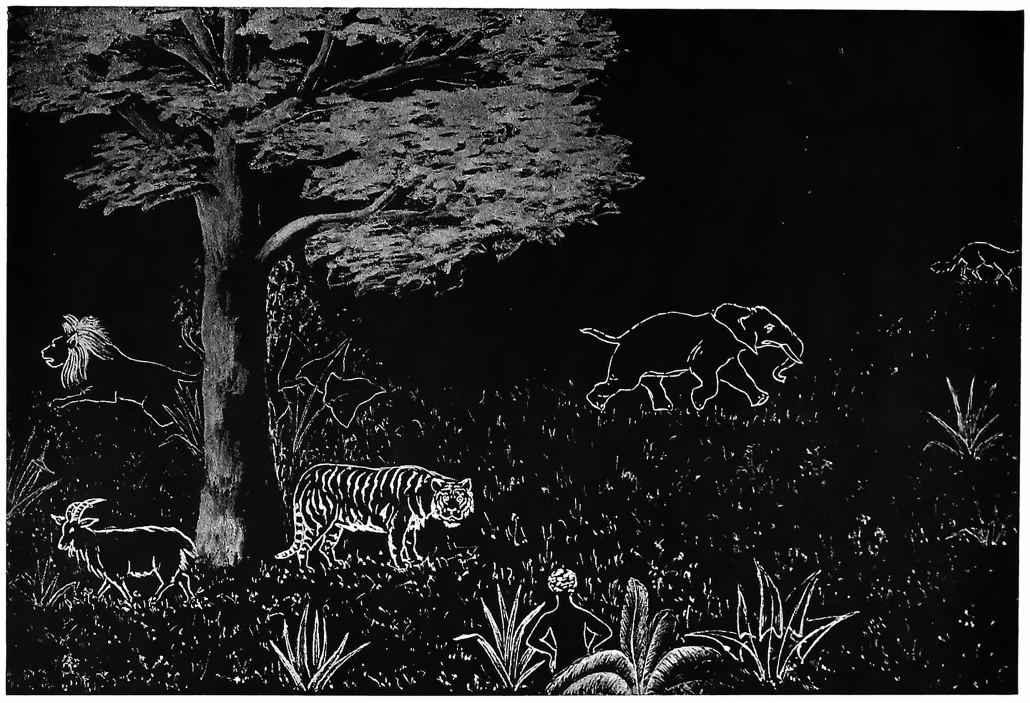
Illustration by Cecilia Sinclair from West African Folk-Tales, collected by W. H. Barker and Cecilia Sinclair (London: George G. Harrap, 1917). Public domain.
– by Bart Bonikowski, Juan Miguel Jimenez, Nathan Nunn, Oscar Stuhler, and Satish Wasti
Among the Blackfoot of the North American plains, bison are treated as relatives rather than as a resource, and relations with them are governed by reciprocity rather than exploitation. The Cree hold that animals are sentient and know more about the world than people do; when an animal is caught, it is because it has chosen that fate, which obliges the hunter to show it respect. In Anishinaabe law, water is not something to be owned or used but an actor in a relationship, with a spirit of its own. Among the Igbo of Nigeria, the land is not property belonging to people — the people belong to the land, and animals such as crocodiles, tortoises, and water birds are messengers of land and water spirits, and so must not be harmed.
These views stand in contrast to the perspective that prevails in much of the West, which assigns intrinsic value primarily to humans and regards the natural world largely in terms of its usefulness to human ends. The difference is not merely philosophical. Whether nature is an active agent or a passive object shapes what obligations humans are thought to have towards it, and what rights it is thought to hold.
Occasionally these worldviews become law. Ecuador’s 2008 constitution formally recognizes the legal personhood of Mother Earth, drawing on the Andean conception of Pacha Mama; Bolivia followed in 2010. New Zealand’s 2017 Te Awa Tupua Act granted legal personhood to the Whanganui River, formalizing the Māori view of ancestral waterways as living entities. Colombia’s Constitutional Court recognized the Atrato River as a rights-bearing subject in 2016. Dozens of jurisdictions have now extended some form of legal standing to lakes, rivers, mountains, and forests.
In our paper, we ask whether differences in how a society conceptualizes the natural world is related to contemporary environmental attitudes and environmental conditions.
A primary challenge is measurement. Ethnographic descriptions are rich, but they are difficult to compare systematically across a broad cross-section of societies. The multidimensional worldviews of societies must be distilled to simple measures that capture the core variation.
Our analysis turns to traditional folktales. Our source is the Folklore Catalogue compiled over several decades by the anthropologist Yuri Berezkin, and introduced to economics by Stelios Michalopoulos and Melanie Xue. It records which of 2,564 narrative motifs were held by each of 958 ethnic groups.
A motif is a short summary of the events in a folktale, and its sentences typically have a subject, an action, and an object. That structure is what we exploit. We process the corpus with the spaCy language pipeline to recover the syntactic relations between words, then we extract subject–verb and subject–verb–object composites. The logic is simple: in the sentence “A kills B,” A has agency, because A is the subject and the one acting; B does not, because B is the object and the one acted upon. We then classified entities by whether they unambiguously represent nature. Animals, plants, and atmospheric or cosmic elements such as sky, rainbow, and moon account for 28 percent of all entity tokens.
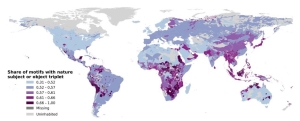
This yields three measures for each group: the share of its motifs mentioning nature at all, the share mentioning nature as a subject, and the share mentioning nature as an object. The appeal of the approach is its objectivity and simplicity. It reads the sentence structure, applies the same rule everywhere, and produces an easily interpretable continuous measure.
We then run two analyses. The first links these measures to environmental attitudes among roughly 300,000 respondents in the World Values Survey and European Values Study, connecting people to ethnic groups through the language they speak at home. We combine four survey items — membership in an environmental group, prioritizing the environment over economic growth, confidence in the environmental protection movement, and a preference for beautifying cities and countryside over achieving economic growth — into a single index, and include demographic controls and subnational region-by-wave fixed effects. We find that respondents from ethnic groups whose folktales mention nature more often, today, express more support for environmental conservation. When we separate subjects from objects, the association is driven by nature appearing as an active subject rather than a passive agent. Interestingly, this relationship only holds for individuals without higher education, suggesting that the persistence of traditional worldviews weakens with formal education.
The second analysis moves beyond reported attitudes and examines environmental outcomes. Using the Ethnologue language polygons to locate where these groups live today, we measure three environmental conditions from remote sensing data in 2000: biodiversity intactness, forest cover, and seasonal surface water. We find that groups whose folktales feature nature have better environmental outcomes. Again, the association is driven by mentions where nature is a subject rather than as an object. That coefficient is stable across specifications that account for human impact, Köppen–Geiger climatic-zone fixed effects, elevation and ruggedness, protected-area coverage, and country fixed effects.
We are careful about what this does and does not show. Folklore is not randomly assigned. Groups living in forested, biodiverse places may have told more stories about animals for the obvious reason that there were more animals around, and those same places may retain more forest today for reasons unconnected to anyone’s worldview. Our controls address this as far as cross-cultural data allows, but our correlations stop short of identifying causal relationships.
What our analysis does establish is that the mental models embedded in oral tradition are measurable, that they vary systematically across societies, and that this variation is not orthogonal to how the environment is thought about and persists in later generations. Furthermore, it is becoming clear that the obstacles to addressing the impending climate crisis are not only technological but cultural, social, and political. How a group views and characterizes nature is a potentially important factor affecting its receptivity to environmentally conscious policies and practices.

