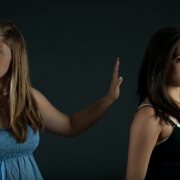
Differences in Men’s and Women’s Friendships Cause Some Differences in Men’s and Women’s Friendship Jealousy

by Jaimie Arona Krems and Keelah Williams

If you’ve read about Gene and his best friend Phineas in John Knowles’ great American novel A Separate Peace, the women alums of Vassar’s class of ’33 in Mary McCarthy’s The Group—or work from Elena Ferrante, Sally Rooney, or pretty much any other author describing dyadic friendships in their wider social world—you’ve read about friendship jealousy. (See also the hilarious ‘Best Friend Toast’ scene from the movie Bridesmaids.) Just as romantic jealousy protects our romantic relationships from third-party threats (e.g., partners defecting to a third party, a third party poaching our partners), we’ve found that third-party threats to our friendships can give rise to feelings of friendship jealousy. But there are some differences in how friendship jealousy plays out across sex/gender.


Of course, as with many phenomena, men and women have more in common than not when it comes to friendship jealousy. We expected—and found upon re-analyzing some of the data from our previous work in U.S. samples—that the inputs and outputs of the friendship jealousy system are the same across sex/gender. The inputs to our friendship jealousy deal primarily with the value of the friend and threat of losing the friend. That is, feelings of friendship jealousy are sensitive to the irreplaceability of our focal friend. We feel greater friendship jealousy when best friendships are threatened than when only mildly close ones are. Feelings of friendship jealousy are also sensitive to the level of ‘replacement threat’ posed by the possible interloper (the person who might steal your friend). I would feel more friendship jealousy if Joel and I always worked out together in the mornings but he started working out with his new friend James than if Joel started to spent tons time socializing with James at work, or than if Joel started spending all his time with a new romantic partner. I’m not his work pal or partner, so he’s not replacing me in the latter instances. Rather, the more the interloper stands to take my place in Joel’s social relationships, the more friendship jealousy I feel. And these feelings of friendship jealousy can cause us to engage in friend guarding—behavior aimed at helping us maintain our friendships. Again, all of this holds across sex/gender.


But in a recent article, we also raised the question of when (and why) we might see sex/gender differences in friendship jealousy.


We began from the premise that common differences in men’s and women’s friendship structures and putative historical functions affect those inputs (and outputs) of the friendship jealousy system. Insofar as these aspects affect the inputs of the system, we should expect some sex/gender differences in friendship jealousy at the prospective loss of same-sex friends. (Because sex/gender segregation in friendships is the norm from early age, we focused on same-sex friends.)


We predicted—and found in samples of U.S. community participants and students—that women report greater friendship jealousy than men at the prospective loss of best friends.


Why? First, women tend to form extremely close one-on-one friendships with one other woman, whereas men tend to form looser multi-male friendship groups. If every person got 100 friend points to invest in friends, this would be like women putting 60 points into a best friend, say, and 20 points in two other close friends, whereas men put 20 points into five friends. This structural difference implies that the value, or irreplaceability, of women’s (versus men’s) best friends might, on average, be higher.


Second, women’s extremely close best friendships are not made overnight; they take much time and effort to form. Moreover, and third, women’s (versus men’s) extremely close friendships often involve a lot of self-disclosure (e.g., which bands I like, which colleagues I hate, tales about that embarrassing time I called my advisor “mom” in a lab meeting). This information is easy ammunition. If I lose my best friend to someone else, that person might learn all my dirty secrets. So, for women, it might be both more costly to replace a best friend and more costly to lose one to someone else.


Fourth, some work suggests that male’s multi-male friendship groups are actually protective against friend loss, and that women’s dyadic friendships are more prone to breaking up—making women’s friendships perhaps more vulnerable to poaching. Indeed, girls sometimes purposefully ‘break-up’ other girls’ dyadic best friendships to poach one of the newly-on-the-market friends, but we knew of no such attacks among boys’ friendships.


We could make a strong prediction that, when faced with their best friends becoming potentially closer to another friend, women might report greater friendship jealousy than men. And they did.


Our next two predictions, focusing on men, were more tentative. First, male (but not female) primates seem to have a long history of banding together in intergroup violence. The relative size of one’s coalition plays a gargantuan role in such conflicts. It’s possible, then, that for men even peripheral allies (e.g., acquaintances) would be somewhat valuable. That is, just as women might value a same-sex best friend more than men do, men might value a same-sex acquaintance more than women do. The size of the effect is small, but we do find that men report greater friendship jealousy at the prospective loss of same-sex acquaintances than women.


Second, this same logic suggests that contexts of intergroup conflict might amplify the value of men’s allies. Thus, we designed an experiment wherein some participants were told to imagine that their same-sex friends were also teammates with whom participants would face off against an opposing team. Moreover, these teammates were not only becoming potentially closer to another friend, but also to the opposing team. (Other participants were asked to imagine friends becoming closer to one’s same-sex rival.) We predicted and found that the intergroup conflict context amplified men’s reported friendship jealousy (at the prospective loss of friends-cum-teammates to rival teams). Again, though, this effect was small.


In all, the structures and perhaps historical functions of men’s and women’s friendships can bear on the inputs to the friendship jealousy system. For example, if I put most of my friendship eggs into a single best friend basket (versus multiple close friend baskets), it makes sense for me to be very sensitive to detecting and responding to threats to my best friend. By affecting these inputs—like the irreplaceability or value of the focal friend—these sex/gender differences in friendship seem to translate into some sensical sex/gender differences in friendship jealousy.


Read the paper: Sex (similarities and) differences in friendship jealousy

Rules of Descent Only Affect Women’s Marital Dispersal

by Ting Ji

Sex-biased dispersal is a widespread phenomenon in animals and humans. Different species show marked contrasts in the patterns of sex-specific dispersal. As for humans, we use the social norms of post-marital residence to regulate sex-specific dispersal at marriage. In most human societies, women leave their natal households and live with their husband’s kin (i.e. parilocality). However, neolocal residence is more popular in industrial societies, i.e. men and women form a new family separate from the kin of either side. Less common patterns include matrilocality, where men move to wife’s household, or ambilocality, where men and women can live with either side of the kin. In a few human societies, such as Mosuo in Southwestern China, the residence is duolocal (or natallocal), where neither men nor women disperse at marriage, husband visits his wife’s household at night, and returns home in the morning. In this society, both men and women live with their close relative for their entire lives. Patterns of sex-biased dispersal structure populations and determine whether an individual is surrounded by relatives or unrelated group members, and thus play an important role in shaping social behaviors.

What predicts the differences in sex-biased dispersal patterns in humans? Anthropologists have long noticed that there is correlation between different social structures in many regions. More specifically, patrilocality is usually associated with patrilineal descent, and matrilocality is associated with matrilineal descent. In other words, in patrilineal societies, descent is traced along male lines, men are more likely than women to remain in natal households, and women are more likely to marry out. In matrilineal societies, descent is traced through female lines, the opposite pattern thus can be found. Is there, however, a causal relation between these two types of kinship norms? Murdock has argued that certain descent systems might arise from different patterns of post-marital residence, i.e., changes of residence drive the change of descent. However, phylogenetic comparative studies show that co-evolutionary trend between these two cultural traits varies in each language family. Different mating systems and local competitions have been proposed to influence sex-biased dispersal as well.

Sex-biased dispersal in humans is also affected by ecological factors. Earlier studies have described dispersal patterns vary in populations with different modes of subsistence. In many hunting, gathering, and fishing societies (foragers), there is no strict rule about which sex should remain and which sex should disperse. Couples often change their residence from time to time. While in horticulture societies, both female-biased and male-biased dispersal are found. Dispersal patterns in pastoralism and agricultural societies, however, are overwhelmingly female-biased. The association between sex-specific dispersal and mode of subsistence has led to the hypothesis that the transition from foraging to agriculture and/or animal husbandry is likely to have promoted female migration. However, the evidence is mixed, with some research finding that the emergence of intensive agriculture, plow agriculture, or large domestic animals hindered matrilcoality and other research suggesting a male-biased dispersal system during the period of the introduction and intensification of agriculture.

As one of the largest language families, the evolutionary history of sex-biased dispersal in Sino-Tibetan has attracted much attention. However, archaeological and genetic studies provide mixed conclusions, and there is still much debate. Moreover, sex-specific models are needed to fully understand the evolution of human dispersal, as post-marital residence and sex-specific dispersal are not always interchangeable. Here we studied the evolutionary history of dispersal norms for males and females in Sino-Tibetan populations, using cultural phylogenetic comparative methods. And we also tested the coevolution of sex-specific dispersal and descent and subsistence.

We collected and analyzed ethnographic data on kinship norms and subsistence from 97 Sino-Tibetan populations. As in many other places around the world, women disperse and men remain in over 85% of the studied Sino-Tibetan populations. Women do not disperse at marriage (as in matrilocal or duolocal residence) in about 5.2% of all societies, whereas approximately 9.3% of the societies lack of strict norms on whether women should disperse or not.

We found that kinship descent likely co-evolved with female dispersal, but not with male dispersal. These findings suggest that in patrilineal societies, dispersal patterns for men are quite flexible, they can choose to move or remain in their natal households. Nevertheless, there is strict control over women’s dispersal. Our results also show that the state of “patrilineal/female disperse” is very stable, and women are unlikely to change their dispersal strategy in patrilineal societies, unless descent changes first.  We also found that female dispersal was likely ancestral, implying that the rare duolocal residence in Mosuo population, in which neither sexes disperse, evolved later. This result is consistent with an earlier genetic study suggesting that the Mosuo might have adopted matriloclaity recently. Furthermore, we found agriculture likely co-evolved with only female dispersal patterns, but the result is sensitive to alternative coding strategy. And we did not find association between domestic cattle and dispersal patterns of either gender. Our results thus illustrated how subsistence or descent can play different roles in shaping male and female dispersal behavior.


Read the paper: A phylogenetic analysis of dispersal norms, descent and subsistence in Sino-Tibetans

HBES 2022 Seeking Volunteers for Conference Support

#HBES2022 Still Virtually Everywhere conference is seeking volunteers from around the world to provide tech support, loading talks for speakers and moderating live Q&A after each talk.

HBES is offering a year’s free membership to volunteers.

Volunteers will receive training in using the platform.

Anyone interested should send the host, Leif, a message ASAP to kennair@ntnu.no

#HBES2022 Important Dates & Information

The host and program committees of #HBES2022 are excited to engage our members in an action-packed, fully customized, online conference experience. Here, you will find all of the information you need to join us (Still) Virtually Everywhere this summer!

HBES 2022 will take place June 22 – June 25. Specific time blocks will be announced soon

The conference will be open to only HBES members and registration will be FREE. You must still register for the conference using the registration form that will open June 1. If you’re not currently a member, please join or renew asap.


HBES Virtually Everywhere will be hosted on the ohyay platform and is a fully-customized online conference where you can 1) grab a coffee with colleagues before heading to a talk, 2) sing karaoke with your friends, or 3) discuss future collaborations at the hotel bar!

For the best virtual experience, we recommend all attendees use Chrome on a plugged-in computer, and strongly encourage the use of headphones so that everyone has a better auditory experience.


We look forward to seeing you all!

If you have questions, please contact the host and program chairs using this form.

Please bookmark the conference webpage for the most up to date information.


Mark your calendars! Here are the important dates you need to know:

  • Abstract submissions opens: April 15th, 2022 (limit one first-author submission per person of any type)
  • Review of abstract submissions will begin on a rolling basis: May 1st, 2022
  • Registration opens: June 1st, 2022
  • Abstract submission deadline and deadlines for New Investigator and Post-Doctoral awards: May 15th, 2022
  • Final abstract acceptance confirmation date: June 1st, 2022
  • Early Registration deadline: June 15th, 2022
  • Late Registration deadline: June 21st, 2022

Invitation to Contribute to Encyclopedias

Todd Shackelford (Psychology, Oakland University) is curating two new encyclopedias, and would like to extend an open invitation to prospective authors interested in contributing entries. Prospective authors are also encouraged to recommend colleagues or graduate students to contribute entries.

The Springer Nature Encyclopedia of Domestic Violence will be a comprehensive encyclopedia of domestic violence, and will include over 2,000 entries from authors across a wide array of disciplines.

The Springer Nature Encyclopedia of Sexual Psychology and Behavior will be a comprehensive encyclopedia of evolutionary perspectives on sexual psychology and behavior, and will also include over 2,000 entries from authors across a wide array of disciplines.

For additional information about either of these encyclopedias, or for a complete list of available entries, please contact Editor-in-Chief Todd Shackelford (shackelf@oakland.edu) or Section Editor Gavin Vance (gvance@oakland.edu).

Call for 2022 HBES Awards Open Until May 1

The Human Behavior and Evolution Society Early Career Award and Lifetime Career Award recognizes individuals for their contributions to the field. We are soliciting nominations (self and other) for each award.


Nominations are due by May 1 2022.


See Awards for more details, eligibility information for each award, and links to submit nominations (under eligibility tabs).