• Login
  • Join/Renew
  • ADAPT Program
HBES
  • Link to X
  • Link to Facebook
  • Link to Mail
  • Home
  • About HBES
  • Conference
  • Journal
  • Awards
  • Places to Study
  • News
  • Click to open the search input field Click to open the search input field Search
  • Menu Menu

Casual sex and the paths to parenthood

October 2, 2026/in Newsletter

– by By Dmitry Grigoryev, Albina Gallyamova, and Elizaveta Komyaginskaya

If someone is more open to casual sex, would you expect them to have more children? The prediction has intuitive appeal: more partners could mean more opportunities for reproduction. In our recent study in Evolution and Human Behavior, however, people who were more open to uncommitted sex than others in their country tended to report fewer children.  Understanding this result requires separating several ideas that are often bundled together: life history trade-offs, mating effort, demographic context, and the pathways through which sexual relationships ultimately become births.

Life history theory starts from a general problem: organisms have limited time and resources, so investment in growth, survival, mating, and parenting involves trade-offs. In parts of the psychological life history literature, these trade-offs have often been organized along a fast–slow continuum, with earlier reproduction, greater mating effort, and openness to casual sex treated as features of a relatively “fast” strategy. But this way of grouping the traits together has become increasingly debated. Recent theoretical and empirical work has questioned whether mating-versus-parenting and offspring quantity-versus-quality are really expressions of the same underlying continuum, and studies do not consistently show that unrestricted sociosexuality goes together with earlier or greater reproduction. Whether these characteristics actually fit together is therefore an empirical question.

Working with an international consortium, we investigated that question using a preregistered analysis plan and data from 80,047 heterosexual adults across 92 countries. We examined sociosexuality: individual differences in openness to sex without commitment. Three questions assessed comfort with casual sex, sexual fantasies about someone just met, and the number of partners with whom respondents had had sex without seeking a committed relationship. We analyzed attitudes and desire together, separately from reported behavior. These questions did not directly measure the time or energy invested in finding partners or raising children.

We also constructed a country-level demographic index combining total fertility, adolescent fertility, and mortality before age 40. Higher scores described relatively faster demographic regimes, with higher fertility, more adolescent births, and greater early mortality. This index characterized national demographic conditions; it did not assign a life history strategy to each respondent. Participants separately reported how many children they had.

Because respondents were nested within countries, we took a multilevel approach and separated two questions that are easy to confuse. One asks whether people who are more sexually unrestricted than others in their own country have more children. The other asks whether countries whose respondents report higher average sociosexuality also have respondents with more children. These comparisons capture different sources of variation—and, as it turned out, they gave different answers. Within countries, people who were more sociosexually unrestricted than the average person in their country reported fewer children. This negative within-country association appeared both for attitudes and desire and for reported behavior. It remained after accounting for age and national reproductive timing, as well as national wealth, education, gender equality, and historical kinship institutions, such as extended-family residence and marriage rules. The associations were modest and stronger among women than men. They also persisted in analyses restricted to parents or respondents aged 40 and older.

A comparison across countries told a different story: countries where respondents reported more uncommitted sexual behavior also tended to have respondents with more children. We did not find the same country-level pattern for attitudes and desires. This does not mean that more sexually unrestricted individuals in those countries had more children. Within the same country, the individual-level association still ran in the opposite direction: more unrestricted individuals tended to report fewer children. This contrast is exactly why separating levels of analysis is so important.

People living in faster demographic regimes also reported more children after country-level adjustment. This is partly unsurprising since fertility itself contributes to our demographic index, but the broader pattern is still informative. In our paper, we treat these regimes as reproductive contexts rather than as psychological strategies carried by every individual: local reproductive timing, kin networks, norms, and institutions may all help make earlier and higher fertility more common and easier to sustain. Faster regimes initially appeared associated with lower sociosexuality, but that association was no longer statistically clear after adjustment for national wealth, education, gender equality, and kinship institutions. Country context also mattered for one specific part of sociosexuality: behavior. In faster demographic regimes, the negative association between a person’s unrestricted sexual behavior and number of children became weaker, especially among men. In other words, unrestricted behavior did not become a fertility advantage overall; rather, it was less strongly associated with having fewer children. One possible interpretation is that where reproduction begins earlier and sexual behavior, partnership, and childbearing remain more tightly coupled, mating behavior has a more direct route to births. Attitudes and desire showed little evidence of this contextual variation, and the behavioral variation was less clear in the older and parent-only samples.

The picture changed most when we took relationship status into account. Accounting for whether respondents were single, married, or in other relationship situations reduced the negative association for attitudes and desire by almost 90%; it was no longer statistically clear. The behavioral association weakened much less and remained negative. Relationships therefore deserve close attention in explaining how sexual dispositions and childbearing become connected.

Why might relationships matter so much? There are at least two directions of influence. Openness to casual sex may be related to the formation and stability of partnerships through which parenthood often occurs. But entering a stable partnership or becoming a parent may also change sexual interests and opportunities. Reliable partners and relatives can help sustain the prolonged demands of raising human children, so stable pair bonds don’t have to mean having fewer children; in some circumstances, they may make several births easier to support. And all of this depends on the surrounding social environment: access to сontraception, expectations about marriage, and available family support may further alter how sexual relationships are realized into births. Our cross-sectional data cannot tell us which of these pathways produced the associations we observed. Beyond the limits of the cross-sectional design, several features of the data also place some limits on how broadly these results can be interpreted. The data was self-reported, and respondents were about 31 years old on average, so many had not completed childbearing. About two-thirds were women. The response scale combined five or more children into one category. Country sample sizes were unequal, and cultural differences in willingness to report sexual experiences could affect comparisons. We left offspring survival and later reproduction unmeasured, so number of children at the time of the survey is therefore only an incomplete measure of lifetime reproductive success.

Even with those limitations, our results are difficult to reconcile with one simple story: that greater openness to casual sex is a straightforward marker of a single “fast” strategy that should also lead to more children. The multilevel approach shows where the pieces come apart. Faster demographic regimes are associated with higher fertility, while within those same societies, more sexually unrestricted individuals tend to report fewer children. They leave open how the underlying dispositions evolved. A useful next step is to follow people—and ideally couples—through partnership formation, first births, and subsequent births to see when and how mating dispositions are actually converted into parenthood. That may be a more useful question than asking whether sociosexuality is simply “fast” or “slow.”
Grigoryev, D., Gallyamova, A., Komyaginskaya, E., et al. (2026). Sociosexual orientation, life history strategy, and reproductive success: A large-scale cross-cultural analysis across 92 contemporary societies. Evolution and Human Behavior, 47(5), 106938.

https://www.hbes.com/wp-content/uploads/2026/10/Picture1-2.jpg 245 367 karthikpanchanathan https://www.hbes.com/wp-content/uploads/2019/07/HBES-banner-2019.png karthikpanchanathan2026-10-02 19:09:072026-10-02 19:09:07Casual sex and the paths to parenthood

Who really believes in magic?

October 2, 2026/in Newsletter

– by Neil Levy, Rob Ross, and Ryan McKay

Anthropology must steer a narrow course between twin dangers. On the one hand, there is the perennial risk of exoticizing other peoples. On the other hand, there is a danger of a failure to recognize genuine difference, rendering somewhat alien worldviews mere variants of our own. Nowhere do these risks loom larger than when it comes to understanding the attitudes of other cultures to magic.

On the one hand, if we interpret magic as an instrumental technology, we are faced with the problem of understanding how rational people could genuinely believe in its efficacy, given the evidence against it. On the other hand, if we deny that they are genuine believers, we risk obscuring their genuine differences from us. The same problem arises closer to home, at least for those of us who accept a squarely secular worldview: how can our neighbors or our families genuinely believe in the supernatural agents of religions?

Non-instrumental accounts of magic (and religion) focus on its roles in fostering a sense of belonging, community, and in satisfying existential needs, without postulating a wholehearted belief in it as an instrumental technology. These accounts are today powerfully challenged by instrumentalist accounts, that maintain that people are, in the main, genuine believers, and suggest that (nevertheless) universal cognitive biases and heuristics can explain a diversity of attitudes to magic, including genuine belief in its efficacy.

We take our inspiration from recent work in political science and psychology (some of it by us) that provides evidence that belief reports are not always sincere. People sometimes insincerely report believing bizarre claims (like some conspiracy theories) or politically relevant claims for a variety of reasons.

One motivation for insincere belief reports is to express an attitude. Political scientists call this expressive responding or partisan cheerleading. For example, people may report believing that the crowd at the first Trump inauguration was bigger than at Obama’s to express support for Trump, just as someone might report believing the Browns are the greatest team to express support for their side, rather than because one genuinely believes.

People may also report believing a conspiracy theory or engaging in a strange behavior (like drinking bleach to prevent COVID-19) for a different reason: to ‘troll’ experimenters or because they think it’s funny.

People may also sincerely but wrongly report their own beliefs. Asked to report what they believe about some question they’ve never explicitly considered before (“will Donald Trump invade Canada?”), people may sample a range of considerations that come to mind and construct a narrative. This report may not reflect their true attitude. The tendency to misreport an attitude may be particularly strong when the attitude is one that is fun to maintain and receives community support.

Most of the evidence, at least from political science and psychology, concerns the belief reports of people in WEIRD societies. We see no reason to think that the reports of people in non-WEIRD society are more likely to be sincere, and (when sincere) accurate. While the accusation that Margaret Mead’s informants were hoaxing them is sharply contested, there’s evidence that informants may troll anthropologists. Salamone quotes one Tiv informant’s ridicule: “When I read what the white man has written of our customs, I laugh, for it is the custom of our people to lie as a matter of course to outsiders, especially the white man.”

The evidence concerning expressive responding, trolling, and the construction of attitudes among WEIRD participants does not suggest that everyone is insincere or mistakenly reporting a belief. Rather, it supports what we call a motley of attitudes: some people are genuine believers, some are trolls, some are sincere but mistaken. The proportion of genuine believers varies from topic to topic, and a single individual may take a variety of attitudes across topics. We think that exactly the same is true of people in non-WEIRD societies when it comes to belief in magic. Some may understand magic symbolically, some may be sincere believers (or disbelievers) in it, and some may have no stable attitude at all.

Instrumentalist accounts offer compelling evidence that some people are really true believers. However, we point to evidence in the anthropological literature to argue that other attitudes exist alongside belief. We suggest that postulating a heterogeneity of attitudes is needed to make sense of many ethnographic reports without attributing a lack of rationality to informants. In his study of Burmese animism, Spiro notes that the beliefs of his informants are “marked by inconsistency, contradiction, and by what might be called cognitive looseness,” with different informants manifesting different degrees of belief ranging from wholehearted acceptance to outright skepticism. We suspect this sort of heterogeneity is widespread across many societies, including our own.

When Evans-Pritchard attributes inconsistent beliefs among the Azande and a blatant failure to “perceive the contradiction” between their beliefs, he risks not only making them alien, but failing to recognize their rationality. While we acknowledge the risk we run of the reverse mistake — of assuming that people from “exotic” societies are entirely like ourselves — we think our suggestion that people of all societies take a motley of attitudes is both more respectful of our shared humanity and more faithful to the evidence.

Neil Levy, Robert M. Ross, and Ryan McKay. A motley of attitudes: belief, insincerity, and non-doxastic commitment in magical practice. Evolution and Human Behavior 47.5 (2026): 106945

https://www.hbes.com/wp-content/uploads/2026/10/default.jpg 1183 2048 karthikpanchanathan https://www.hbes.com/wp-content/uploads/2019/07/HBES-banner-2019.png karthikpanchanathan2026-10-02 19:03:542026-10-06 13:05:02Who really believes in magic?

When Nature Has Agency: What Folktales Tell Us About Environmental Attitudes

October 2, 2026/in Newsletter

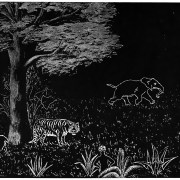
Illustration by Cecilia Sinclair from West African Folk-Tales, collected by W. H. Barker and Cecilia Sinclair (London: George G. Harrap, 1917). Public domain.

– by Bart Bonikowski, Juan Miguel Jimenez, Nathan Nunn, Oscar Stuhler, and Satish Wasti

Among the Blackfoot of the North American plains, bison are treated as relatives rather than as a resource, and relations with them are governed by reciprocity rather than exploitation. The Cree hold that animals are sentient and know more about the world than people do; when an animal is caught, it is because it has chosen that fate, which obliges the hunter to show it respect. In Anishinaabe law, water is not something to be owned or used but an actor in a relationship, with a spirit of its own. Among the Igbo of Nigeria, the land is not property belonging to people — the people belong to the land, and animals such as crocodiles, tortoises, and water birds are messengers of land and water spirits, and so must not be harmed.

These views stand in contrast to the perspective that prevails in much of the West, which assigns intrinsic value primarily to humans and regards the natural world largely in terms of its usefulness to human ends. The difference is not merely philosophical. Whether nature is an active agent or a passive object shapes what obligations humans are thought to have towards it, and what rights it is thought to hold.

Occasionally these worldviews become law. Ecuador’s 2008 constitution formally recognizes the legal personhood of Mother Earth, drawing on the Andean conception of Pacha Mama; Bolivia followed in 2010. New Zealand’s 2017 Te Awa Tupua Act granted legal personhood to the Whanganui River, formalizing the Māori view of ancestral waterways as living entities. Colombia’s Constitutional Court recognized the Atrato River as a rights-bearing subject in 2016. Dozens of jurisdictions have now extended some form of legal standing to lakes, rivers, mountains, and forests.

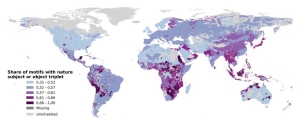
In our paper, we ask whether differences in how a society conceptualizes the natural world is related to contemporary environmental attitudes and environmental conditions.

A primary challenge is measurement. Ethnographic descriptions are rich, but they are difficult to compare systematically across a broad cross-section of societies. The multidimensional worldviews of societies must be distilled to simple measures that capture the core variation.

Our analysis turns to traditional folktales. Our source is the Folklore Catalogue compiled over several decades by the anthropologist Yuri Berezkin, and introduced to economics by Stelios Michalopoulos and Melanie Xue. It records which of 2,564 narrative motifs were held by each of 958 ethnic groups.

A motif is a short summary of the events in a folktale, and its sentences typically have a subject, an action, and an object. That structure is what we exploit. We process the corpus with the spaCy language pipeline to recover the syntactic relations between words, then we extract subject–verb and subject–verb–object composites. The logic is simple: in the sentence “A kills B,” A has agency, because A is the subject and the one acting; B does not, because B is the object and the one acted upon. We then classified entities by whether they unambiguously represent nature. Animals, plants, and atmospheric or cosmic elements such as sky, rainbow, and moon account for 28 percent of all entity tokens.

This yields three measures for each group: the share of its motifs mentioning nature at all, the share mentioning nature as a subject, and the share mentioning nature as an object. The appeal of the approach is its objectivity and simplicity. It reads the sentence structure, applies the same rule everywhere, and produces an easily interpretable continuous measure.

We then run two analyses. The first links these measures to environmental attitudes among roughly 300,000 respondents in the World Values Survey and European Values Study, connecting people to ethnic groups through the language they speak at home. We combine four survey items — membership in an environmental group, prioritizing the environment over economic growth, confidence in the environmental protection movement, and a preference for beautifying cities and countryside over achieving economic growth — into a single index, and include demographic controls and subnational region-by-wave fixed effects. We find that respondents from ethnic groups whose folktales mention nature more often, today, express more support for environmental conservation. When we separate subjects from objects, the association is driven by nature appearing as an active subject rather than a passive agent. Interestingly, this relationship only holds for individuals without higher education, suggesting that the persistence of traditional worldviews weakens with formal education.

The second analysis moves beyond reported attitudes and examines environmental outcomes. Using the Ethnologue language polygons to locate where these groups live today, we measure three environmental conditions from remote sensing data in 2000: biodiversity intactness, forest cover, and seasonal surface water. We find that groups whose folktales feature nature have better environmental outcomes. Again, the association is driven by mentions where nature is a subject rather than as an object. That coefficient is stable across specifications that account for human impact, Köppen–Geiger climatic-zone fixed effects, elevation and ruggedness, protected-area coverage, and country fixed effects.

We are careful about what this does and does not show. Folklore is not randomly assigned. Groups living in forested, biodiverse places may have told more stories about animals for the obvious reason that there were more animals around, and those same places may retain more forest today for reasons unconnected to anyone’s worldview. Our controls address this as far as cross-cultural data allows, but our correlations stop short of identifying causal relationships.

What our analysis does establish is that the mental models embedded in oral tradition are measurable, that they vary systematically across societies, and that this variation is not orthogonal to how the environment is thought about and persists in later generations. Furthermore, it is becoming clear that the obstacles to addressing the impending climate crisis are not only technological but cultural, social, and political. How a group views and characterizes nature is a potentially important factor affecting its receptivity to environmentally conscious policies and practices.

Bart Bonikowski, Juan Miguel Jimenez, Nathan Nunn, Oscar Stuhler, and Satish Wasti. When nature has agency: Traditional worldviews and contemporary environmental conservation. Evolution and Human Behavior 47.5 (2026): 106942.

https://www.hbes.com/wp-content/uploads/2026/10/badboy_upscaled-scaled.png 1748 2560 karthikpanchanathan https://www.hbes.com/wp-content/uploads/2019/07/HBES-banner-2019.png karthikpanchanathan2026-10-02 18:57:222026-10-02 18:57:22When Nature Has Agency: What Folktales Tell Us About Environmental Attitudes

What do people want in a friend? Ancestral cooperation shaped contemporary friend preferences

October 2, 2026/in Newsletter

– by Adar Eisenbruch

How do people choose their friends? Given how ubiquitous friendships are, you might think that the answer to this question would be obvious and well-established. In reality, we’re still learning a lot about friendship formation. There are two broad theories of why people choose the friends that they choose. The standard in social psychology is called the “instrumentality principle,” which states that people are attracted to potential friends with traits that are useful for their current goals. Want to play basketball? You’re going to want tall friends. Hungry? Time to hang out with that guy who went to culinary school. Need help with your math homework? The nerd down the hall suddenly seems pretty cool.

Evolutionary psychologists have suggested another theory, which my colleagues and I have called “social taste buds.” On this theory, people have evolved friend preferences, just like we have evolved food preferences and mate preferences. Since friendship likely evolved as a form of long-term, ongoing cooperative relationship, we hypothesize that people want friends with traits that would have contributed to cooperative partner value in ancestral environments. For example, cues of generosity, trustworthiness, health, and the ability to produce resources as a forager should all be attractive in a potential friend.

We recently tested this theory in two studies reported in Evolution and Human Behavior. In Study 1, we had pairs of unacquainted, same-sex college students come to the lab. After a half-hour conversation, the participants privately rated each other on friend desirability and on traits that might predict friend desirability (e.g. trustworthiness, attractiveness, ability as a hunter-gatherer). At the end of the study, the participants had the opportunity to leave their email address for the other person so that they could meet up outside the lab. We actually exchanged their email addresses if both participants wanted to.

Overall, ratings of ancestral productivity (the ability to produce resources as a hunter-gatherer), attractiveness, prosociality, dominance, social status, nurturance (the ability to take care of kin), and knowledge of what the other sex likes were all positive predictors of friend desirability. Two preferences in particular support the social taste buds theory. First is the preference for physically attractive friends, which was the single strongest preference. This seems like a strange thing to want in a same-sex friend – what good is a friend’s attractiveness to you? But physical attractiveness is likely a summary judgment of partner value. Attractiveness is based on a combination of cues of health, maturity, strength, etc. Since so many of the traits that made someone a good mate likely also made them a good cooperative partner, we suggest that humans evolved a preference for physical attractiveness in same-sex relationships too.

The second is the preference for ancestral productivity, that is, the ability to produce resources as a hunter-gatherer, which was stronger among men than women. This is another bizarre trait for undergraduates to want in a friend – the campus dining halls don’t make students forage for their dinner. It makes sense, however, if friend preferences evolved as cooperative partner preferences, and men faced stronger selection pressures for choosing good hunting partners.

Another sex difference was also striking. Recall that the participants had the opportunity to leave their contact info for the other participant so that they could continue their relationship outside the lab. Men were significantly more likely than women to leave their contact information for the other person (50% vs. 30%). This wasn’t because the men found their partners more desirable as friends. Instead, at any level of friend desirability, men were more likely than women to initiate a real-world friendship. This is consistent with the hypothesis that men have evolved a looser friendship style than women in order to facilitate building a flexible network of cooperative partners and allies. Previous studies have found that men prefer to have more, but less intimate, friendships than women, but this is the first observation of men’s lower friendship standards affecting real relationship formation.

Notice that many of the preferences we observed could be explained by either theory. A preference for friends high in prosociality or social status, for example, could be due to ancestral selection pressures or due to the relevance of those traits for current goals. We therefore conducted a second study that compared participants’ friend preferences to the traits that they said would be useful for their current goals. Participants first spent a few minutes writing about their most important current goal, then they rated 11 traits on how much a friend having each trait would help them achieve their goal. The participants then rated same-sex faces for how much they wanted to be friends with each person. The faces had also been rated on the same 11 traits, so we could calculate the effect of each trait on participants’ friend desirability judgments and compare it to the trait’s goal-relevance.

Attractiveness, extraversion, and ancestral productivity were more attractive in a potential friend than could be explained by their goal-relevance, suggesting that the preferences for those traits were not motivated by current goals. Overall, there was little evidence that preferences were calibrated to current utility, but stronger evidence of preferences like those observed in Study 1 irrespective of their current goal-relevance.

Of course, the instrumentality principle and the social taste buds theory are not mutually exclusive. These studies provided clear evidence of evolved friend preferences, but it’s very likely that people sometimes choose their friends based on evolved preferences and sometimes to serve their current goals. This would match how people choose foods; sometimes your dietary goals lead you to order a salad, and sometimes your evolved preferences win and you order an ice cream sundae. Researchers can now proceed to the interesting question of how these two types of preferences are integrated with each other.

Adar B. Eisenbruch, Rachel L. Grillot, and James R. Roney. What do people want in a friend? Cues of ancestral cooperative partner value predict same-sex friend preferences. Evolution and Human Behavior 47.5 (2026): 106919.

https://www.hbes.com/wp-content/uploads/2026/10/Picture1.jpg 409 613 karthikpanchanathan https://www.hbes.com/wp-content/uploads/2019/07/HBES-banner-2019.png karthikpanchanathan2026-10-02 18:49:202026-10-02 18:49:20What do people want in a friend? Ancestral cooperation shaped contemporary friend preferences

Tenure-track position in the Department of Psychology – UC San Diego

October 2, 2026/in Newsletter, Uncategorized

The Department of Psychology at UC San Diego invites applications for a tenure-track Assistant Professor position focused on high-level human cognition, with an anticipated start date of July 1st, 2027. We seek candidates ready to establish a rigorous, independent research program on high-level cognitive processes in humans (e.g. aesthetics, attention, attitudes, decision-making, effort, inference, language, learning, memory, preferences, reasoning, self-control, social cognition, well-being) that leverages insights from experimental research to inform formal/computational theories. Ideal candidates will possess strong empirical, theoretical, and quantitative skills, with the potential to bridge between areas of the department. Additional responsibilities include teaching graduate- and undergraduate-level courses and mentoring students within the Department of Psychology, as well as participating in department and university service.

For more information, visit this link.

https://www.hbes.com/wp-content/uploads/2026/10/californiauniversitysandiego-368189863.png 1200 1200 karthikpanchanathan https://www.hbes.com/wp-content/uploads/2019/07/HBES-banner-2019.png karthikpanchanathan2026-10-02 18:40:342026-10-02 18:40:42Tenure-track position in the Department of Psychology – UC San Diego
Page 2 of 212
Search Search

Categories

  • Admin (5)
  • AltAc (1)
  • Announcements (151)
  • Anthropology (48)
  • Awards (9)
  • Behavioral Ecology (18)
  • Biology (24)
  • Call for Papers (28)
  • Conferences (44)
  • Courses (4)
  • Economics (6)
  • Events (21)
  • Funding (11)
  • Jobs (89)
  • Journal (3)
  • Linguistics (3)
  • Newsletter (260)
  • PhD Students (53)
  • Postdocs (47)
  • Psychology (84)
  • Uncategorized (22)

Contacts

Membership
Journal Subscription
Contact Form

Communications Officer
Contact Form

Grant Proposals
Submission Form

Grievance Committee
Contact Form

Website
Places to Study
Contact Form

Donate to HBES

Donate Here
Member Login
Not a member? Join HBES
© HBES Copyright.
  • Link to X
  • Link to Facebook
  • Link to Mail
  • Home
  • About HBES
  • Conference
  • Journal
  • Awards
  • Places to Study
  • News
Scroll to top Scroll to top Scroll to top